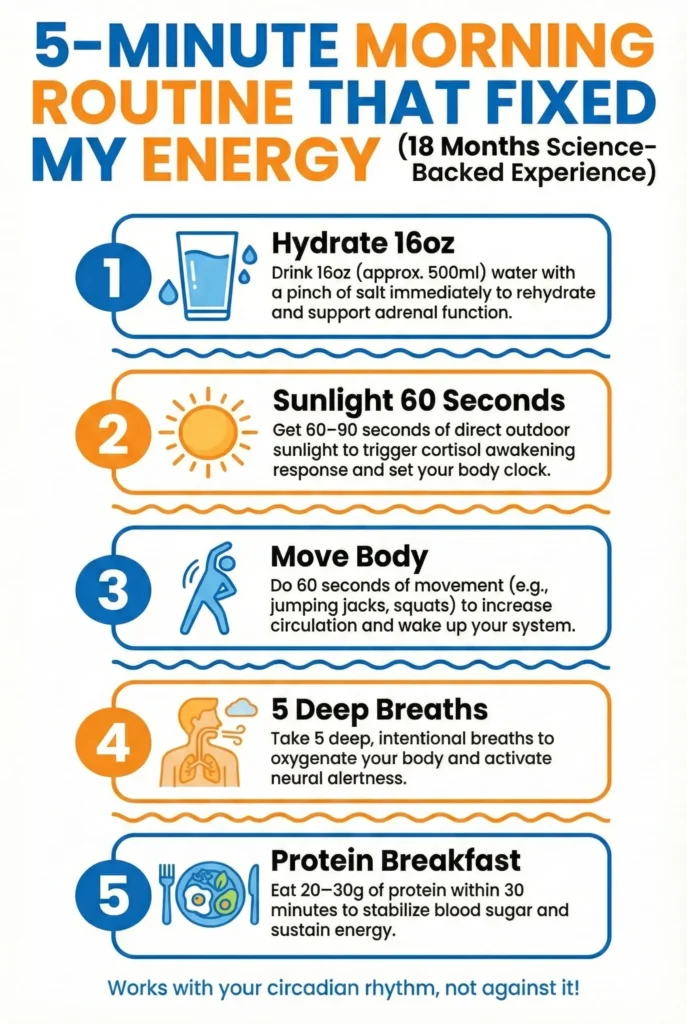

I’ve been doing this routine every morning for the past 18 months. My energy is stable all day, I don’t need coffee to function anymore (though I still drink it), and I haven’t had an afternoon crash in over a year.
This guide explains the science behind why most morning routines fail, the biological mechanisms that control morning energy, and the exact 5-minute protocol that fixed my energy for good.
Why Most Morning Routines Fail
The problem with most morning routines isn’t that they don’t work—it’s that they require perfect conditions and unsustainable willpower.
The “Miracle Morning” approach: Wake at 5 AM. Meditate for 10 minutes. Journal for 10 minutes. Read for 20 minutes. Exercise for 20 minutes. Cold shower for 5 minutes. Healthy breakfast. Total time: 90+ minutes.
Sounds great in theory. In practice? You need to wake up insanely early, you need zero kids or life obligations, and you need the discipline of a monk. Miss one component and you feel like you’ve already failed your day at 6 AM.
The biohacker routine: Red light therapy. Grounding. Mushroom coffee. Supplements. Ice bath. Breathwork. Requires thousands of dollars in equipment and an hour of time. Not realistic for most people.
The productivity routine: Wake at 4:30 AM. Plan your day. Attack your most important task before breakfast. This works until you have one late night, then your entire system collapses.
Here’s what all these routines get wrong: they ignore your circadian rhythm and how your body naturally wakes up.
Your body has a built-in wake-up system. When it works properly, you don’t need elaborate routines—you just need to support what’s already happening biologically.
The Science of Morning Energy: Cortisol and Your Circadian Rhythm
Here’s what’s actually happening in your body when you wake up.
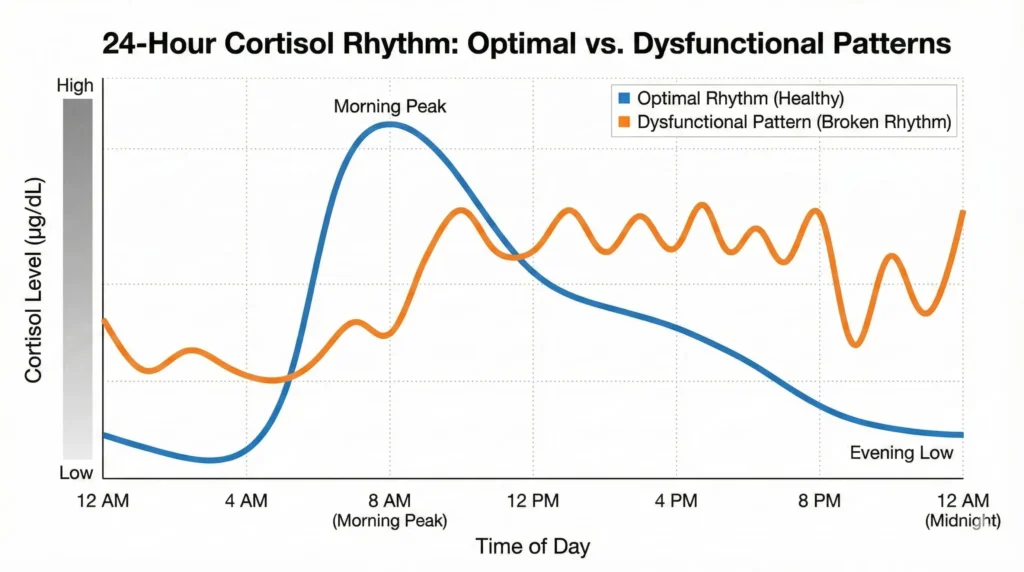
About 30-60 minutes before you naturally wake up, your body starts releasing cortisol. Yes, the “stress hormone”—but in this context, it’s your natural wake-up signal.
The cortisol awakening response (CAR) is one of the most important biological processes for energy. Cortisol peaks right when you wake up, then gradually declines throughout the day, reaching its lowest point around midnight.
This isn’t random. Cortisol in the morning:
– Increases blood sugar (gives you energy)
– Suppresses melatonin (kills grogginess)
– Boosts alertness and focus
– Prepares your muscles for activity
– Kickstarts your metabolism
When this system works correctly, you wake up naturally alert. No alarm needed. No grogginess. Just smooth, gradual awakening.
But most people’s cortisol rhythm is completely broken.
What breaks your cortisol awakening response:
– Going to bed at different times every night
– Looking at screens right before bed
– Sleeping in total darkness (no natural light cues)
– Staying inside all day (no sunlight exposure)
– High stress (chronic cortisol elevation flattens the morning spike)
– Poor sleep quality
– Eating late at night
When your cortisol rhythm is broken, you wake up exhausted despite sleeping 8 hours. You’re foggy all morning. You need coffee just to feel human. And by 2 PM, you crash.
The solution isn’t another elaborate routine. It’s fixing your circadian rhythm so your natural wake-up system works again.
The 5-Minute Morning Routine That Actually Works
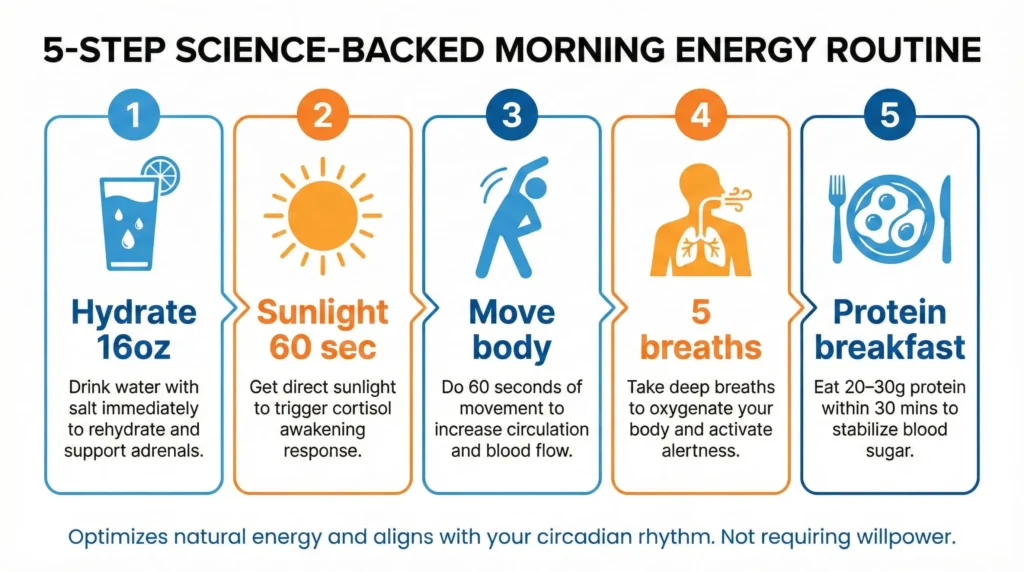
This routine supports your body’s natural wake-up process instead of fighting it. Each step takes about 1 minute. Total time: 5 minutes.
You can do this in your pajamas. You don’t need to wake up early. You don’t need equipment. You just need to do these five things in order.
Step 1: Hydrate Immediately (60 seconds)
Before coffee. Before breakfast. Before checking your phone. Drink 16-20 ounces of water.
Your body loses about 1-2 pounds of water overnight through breathing and sweating. By morning, you’re mildly dehydrated. Dehydration makes you feel tired, foggy, and sluggish—symptoms people mistake for “needing coffee.”
What I drink: Room temperature water with a pinch of sea salt (about 1/4 teaspoon). The salt provides electrolytes—sodium and trace minerals—that help your cells actually absorb the water.
Why it works: Rehydration increases blood volume, which improves oxygen delivery to your brain. Within 10 minutes, you’ll feel noticeably more alert. This isn’t placebo—studies show even mild dehydration (1-2% body weight) significantly impairs cognitive function.
The mistake people make: Drinking coffee first. Coffee is a diuretic—it makes you pee out more water than you take in. If you’re dehydrated, coffee makes it worse.
Check out our complete morning hydration guide for more details on electrolyte balance.
Step 2: Get Outside for Sunlight (60-90 seconds)
This is the single most important step. Go outside. Face the direction of the sun (don’t look directly at it). Stand there for 60-90 seconds.
Why it works: Morning sunlight hits your eyes and triggers a cascade of biological signals:
Sunlight suppresses melatonin (the sleep hormone) and increases cortisol, helping you feel more awake and alert. Even on cloudy days, outdoor light is 10-100x brighter than indoor lighting. Your brain uses this light signal to set your circadian clock—telling your body “it’s daytime, time to be awake.”
A morning spike in cortisol will positively influence your immune system, metabolism and ability to focus during the day.
How long: On sunny days, 60-90 seconds is enough. On cloudy days, aim for 2-3 minutes. The key is getting outside within the first hour of waking—preferably within 30 minutes.
Common questions:
– **Through a window?** No. Glass filters out the wavelengths your brain needs.
– **Sunglasses?** No. The light needs to hit your eyes (don’t stare at the sun, just face its direction).
– **What if it’s dark when I wake up?** Turn on bright overhead lights immediately, then get sunlight as soon as the sun rises.
I combine this with drinking my water outside. Two steps done simultaneously.
Step 3: Move Your Body (60 seconds)
Not exercise. Not a workout. Just movement. Anything that gets your blood flowing and joints moving.
What I do: Five simple stretches or movements:
1. Arm circles (10 forward, 10 backward)
2. Bodyweight squats (10 reps)
3. Torso twists (10 each side)
4. Forward fold (touch toes, hold 10 seconds)
5. Cat-cow stretches (10 reps)
Takes exactly 60 seconds. Sometimes I do this outside while getting sunlight. Two-for-one.
Why it works: Movement increases heart rate and circulation, delivering more oxygen and nutrients to your brain and muscles. It also triggers the release of neurotransmitters like dopamine and norepinephrine that increase alertness.
You’re not trying to get a workout. You’re telling your body: “We’re awake now. Time to move.”
Step 4: Take 5 Deep Breaths (30 seconds)
Simple breathwork. Nothing fancy.
How to do it:
– Inhale deeply through your nose for 4 seconds (belly expands, not chest)
– Hold for 2 seconds
– Exhale slowly through your mouth for 6 seconds
– Repeat 5 times
Why it works: Deep breathing activates your parasympathetic nervous system (calm, alert state) and increases oxygen delivery to your brain. It also shifts you out of shallow chest breathing—which most people do unconsciously and which keeps you in a semi-stressed state.
This takes 30-60 seconds total. I usually do this right after movement, still standing outside.
Step 5: Eat Protein Within 30 Minutes (5 minutes)
Your first meal matters. Protein stabilizes blood sugar, reduces cravings, and keeps you full until lunch.
What I eat: 3 eggs scrambled with vegetables. Sometimes I add avocado or leftover meat. Takes 5 minutes to make.
Other easy options:
– Greek yogurt with nuts
– Protein shake with real ingredients (not powder junk)
– Leftover chicken or fish
– Cottage cheese with berries
Minimum target: 20-30 grams of protein in your first meal.
Why it works: Protein triggers satiety hormones (peptide YY, GLP-1) that keep hunger stable. It also provides amino acids needed for neurotransmitter production—dopamine, norepinephrine, serotonin—all of which affect your energy and mood.
What not to eat: Carbs alone (toast, cereal, pastries, juice). These spike blood sugar, trigger insulin release, then crash your energy within 2 hours. You’ll be hungry and tired by 10 AM.
If you’re doing intermittent fasting, skip this step or time your eating window to include a protein-rich first meal. Learn more about combining fasting with energy optimization.
Why This Routine Works When Others Don’t
Most morning routines fail because they’re built on willpower and discipline. This routine works because it’s built on biology.
It’s fast. Five minutes. You can do this even on your busiest mornings. No excuses. Even if you’re running late, you can hydrate (30 seconds), step outside (60 seconds), and eat something (2 minutes). Done.
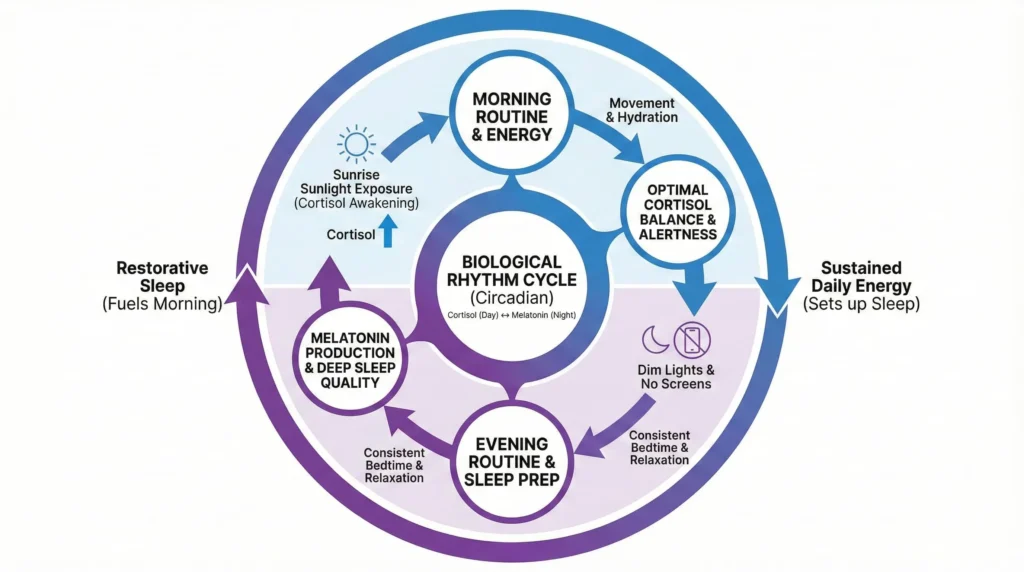
It works with your circadian rhythm, not against it. Every step supports your natural cortisol awakening response and circadian clock. You’re not forcing anything—you’re just removing the obstacles that were blocking your body’s natural wake-up system.
It doesn’t require willpower. There’s no 5 AM alarm. No ice bath. No 30-minute meditation. Just five simple actions that feel easy because they’re helping you feel better, not making you suffer.
It compounds. Each step makes the next step easier. Hydration makes you feel less foggy, which makes it easier to go outside. Sunlight boosts your cortisol, which makes movement feel more natural. Movement increases circulation, which makes breathing deeper. Protein stabilizes blood sugar, which prevents the mid-morning crash.
It’s flexible. You can do it at 6 AM or 9 AM. You can do it on weekends. You can do it while traveling. The routine adapts to your life instead of demanding your life adapt to it.
What to Expect: Timeline for Results
Don’t expect instant transformation. Your circadian rhythm takes time to reset.
Day 1-3: You’ll notice immediate improvements in how you feel after doing the routine—more alert, less foggy. But your overall energy might still be inconsistent. That’s normal. Your body is adjusting.
Week 1: Morning grogginess decreases. You’ll start waking up more naturally, even before your alarm. Afternoon energy is more stable—less crashing.
Week 2-3: This is where it clicks. Your cortisol rhythm is starting to normalize. You wake up feeling more refreshed. Energy is consistent throughout the day. You don’t need as much coffee (or any).
Week 4+: Full benefits. Waking up feels easy. You have natural, stable energy all day. Sleep quality improves because your circadian rhythm is locked in. This becomes your new normal.
Give it a full month before deciding if it works. Most people quit after 3-4 days because they’re still adjusting and don’t see dramatic results yet.
Common Mistakes That Kill Your Morning Energy
Checking your phone first thing. Blue light from screens suppresses your natural cortisol spike and tricks your brain into thinking it’s still nighttime. Wait at least 30-60 minutes after waking before looking at screens. Do your routine first.
Drinking coffee before water. You’re dehydrated. Coffee dehydrates you more. This makes you feel worse, not better. Hydrate first, coffee second (if you even want it after hydrating properly).
Skipping sunlight on cloudy days. Even through clouds, outdoor light is significantly brighter than indoor lighting. Your circadian clock still benefits. Don’t skip this step.
Eating carbs for breakfast. Toast, cereal, bagels, pastries—these spike your blood sugar, then crash it within 2 hours. You’ll be starving and exhausted by mid-morning. Prioritize protein and healthy fats.
Inconsistent sleep schedule. If you’re going to bed at midnight one night and 9 PM the next, your circadian rhythm never stabilizes. Try to keep your sleep schedule within a 1-hour window, even on weekends. Check our evening routine guide for better sleep consistency.
Staying inside all day. Morning sunlight helps, but you also need light exposure throughout the day. If you work indoors under artificial lights, your circadian rhythm weakens over time. Get outside for 10-15 minutes at lunch if possible.
Doing too much. Don’t add a 30-minute workout, cold shower, journaling, and meditation to this routine. Keep it simple. Five minutes. That’s it. You can add other habits later once this routine is automatic.
How to Make It Stick
The hardest part isn’t doing the routine—it’s remembering to do it consistently.
Set up your environment:
– Put a full water bottle on your nightstand before bed
– Put your shoes/slippers by the door so going outside is frictionless
– Prep breakfast ingredients the night before (eggs in a bowl, vegetables chopped)
Stack it with existing habits: Most people already have a morning routine—it’s just not optimal. You probably already wake up, use the bathroom, and stumble to the kitchen. Insert these five steps into that existing flow.
Example flow:
1. Wake up → drink water (already on nightstand)
2. Use bathroom → put on shoes
3. Step outside for 60 seconds → do 5 movements
4. Come back inside → make eggs
5. Eat breakfast → now start your normal routine (coffee, shower, etc.)
Track it for 30 days: Put a calendar on your wall. Check off each day you complete all five steps. The visual reminder helps. After 30 days, it’s automatic.
Don’t aim for perfection: You’ll miss days. That’s fine. One missed day doesn’t ruin your progress. Just get back to it the next morning. Consistency over perfection.
Optional Additions (After You’ve Mastered the Basics)
Once this 5-minute routine is automatic (after 4-6 weeks), you can add more if you want.
Cold exposure: End your shower with 30-60 seconds of cold water. Increases alertness and norepinephrine. But don’t add this until the basic routine is effortless.
Light exercise: A 10-15 minute walk after breakfast. Improves glucose metabolism and extends the circadian benefits of morning sunlight.
Journaling: 2-3 minutes of brain dump or gratitude. Helps process thoughts and set intentions. But again—master the basics first.
Meditation: 5-10 minutes of mindfulness or breathwork. Reduces stress and improves focus. Start small if you add this.
I personally don’t do any of these consistently. The 5-minute routine is enough. I occasionally add a morning walk, but I don’t force it.
The point: you don’t need an hour-long routine to have great energy. Five minutes is enough if you’re doing the right things.
The Evening Connection: Why Your Morning Starts the Night Before
You can’t fix your morning energy without fixing your evening routine.
What kills your morning energy at night:
– Staying up past 11 PM (cortisol can’t peak properly if you’re not getting enough sleep)
– Screens before bed (blue light suppresses melatonin and delays sleep)
– Eating within 2-3 hours of bed (insulin and blood sugar spikes interfere with sleep quality)
– Inconsistent bedtime (confuses your circadian clock)
What helps:
– Consistent bedtime (within 30-60 minutes, every night)
– Dim lights after sunset (or use blue-blocking glasses)
– No screens 1 hour before bed (or use night mode)
– Cool, dark bedroom (65-68°F, blackout curtains)
– Magnesium before bed (400mg helps with sleep and morning energy)
Your morning routine and evening routine are two sides of the same coin. Fix both and your energy stabilizes all day.
Read our complete evening optimization guide for more details.
My Results After 18 Months
I’ve been doing this 5-minute routine every morning for a year and a half. Here’s what actually changed:
Morning energy: I wake up naturally around 6:30-7:00 AM, usually before my alarm. No grogginess. No “snooze button” habit. I’m alert within 5-10 minutes of waking.
Daytime energy: Stable all day. No afternoon crash. I don’t need coffee to function (though I still drink one cup because I enjoy it). My focus is sharp until about 8-9 PM.
Sleep quality: Falling asleep is easy. I’m usually in bed by 10 PM and asleep by 10:30. Wake up once at most during the night. Deep sleep improved significantly.
Mood: More stable. Less reactive to stress. Morning used to be when I felt most anxious. Now it’s when I feel best.
Consistency: This is the first morning routine I’ve stuck with for more than a month. It’s so fast and simple that I can’t talk myself out of it. Even when I’m traveling or sleep poorly, I still do it.
What surprised me: How much less coffee I need. I used to drink 3-4 cups just to feel functional. Now I drink one cup because I like the taste, not because I need the caffeine. My body’s natural wake-up system works again.
Frequently Asked Questions
What if I can’t get sunlight in the morning (winter, early work schedule)?
Get outside as soon as the sun is up, even if that’s during your lunch break. In the meantime, use bright overhead lights immediately upon waking (10,000 lux or brighter). A light therapy box can help, but natural sunlight is always better when available.
Can I drink coffee right after waking up?
It’s better to wait 60-90 minutes. Your cortisol is naturally peaking in the first hour after waking. Adding caffeine during this peak can create tolerance and dependency. Drink water first, do your routine, then have coffee. You’ll need less and feel better.
What if I’m not hungry in the morning?
That’s often a sign of poor circadian rhythm or eating too late the night before. Try eating dinner earlier (at least 3 hours before bed) for a week—your morning appetite should return. If you’re doing intermittent fasting intentionally, that’s different—skip the breakfast step and break your fast later with protein.
Do I need to do all five steps or can I just do some?
All five work synergistically. But if you can only do one or two, prioritize: (1) Hydration and (2) Sunlight. Those two alone will give you 70% of the benefits.
How long until I don’t need an alarm anymore?
Most people start waking up naturally within 2-3 weeks of consistent practice. Your circadian rhythm becomes strong enough that your body wakes itself up at the right time. But keep an alarm as a backup—just in case.
What if I wake up at different times (shift work, irregular schedule)?
This routine still helps, but your circadian rhythm will be weaker. Do the five steps whenever you wake up. Try to keep your sleep timing as consistent as possible, even if that timing isn’t “normal.” If you work nights, your routine happens when you wake up in the afternoon—same principles apply.
Can I do this routine if I have young kids who wake me up early?
Yes. You might be woken abruptly by a crying toddler instead of waking naturally, but you can still do the routine once you’re up. Hydrate, step outside with the kids for a minute, move around, breathe, eat protein. It’s flexible enough to work even with chaos.
Final Thoughts
Most people overcomplicate morning routines. They think more is better—longer routines, more habits, more discipline.
But your body doesn’t need more complexity. It needs you to stop fighting your biology.
You have a built-in wake-up system. It’s called your circadian rhythm. When it works properly, waking up is easy, energy is stable, and sleep is restorative.
This 5-minute routine isn’t about adding more to your morning. It’s about removing the obstacles that were preventing your natural wake-up system from functioning.
Hydrate. Get sunlight. Move. Breathe. Eat protein.
Five minutes. That’s it.
Do this consistently for 30 days and your energy will change. Not because of willpower or discipline. Because you finally started working with your biology instead of against it.
For more on optimizing your cellular energy, check out our guide on mitochondrial health and metabolism. And if you want to amplify these benefits, learn about how ketones enhance morning energy.
Your best mornings are ahead of you.

Elena Hartwell is a wellness educator specializing in sleep optimization, metabolic health, and natural weight management. After years of struggling with exhaustion and unexplained weight gain despite “doing everything right,” Elena discovered the powerful connection between sleep quality, gut health, and metabolism—a breakthrough that transformed her life and inspired her mission. Today, she translates cutting-edge research into simple, actionable strategies that help readers sleep better, lose stubborn weight naturally, and reclaim their energy. Elena’s evidence-based approach has helped thousands break free from the diet-exercise cycle by addressing the root cause: disrupted sleep and metabolic dysfunction.