If you’ve tried keto and felt exhausted instead of energized, you’re not alone. Most people quit within the first week because they experience brain fog, fatigue, and zero energy—the opposite of what keto promises.
But here’s what nobody tells you: Keto gives you more energy than carbs—but only after your body learns to use ketones efficiently. The secret isn’t just cutting carbs. It’s understanding how keto works for energy at the cellular level, specifically how ketones fuel your mitochondria differently than glucose.
I tried keto three times before it finally worked. The first two times, I felt terrible and quit. The third time, I focused on mitochondrial adaptation and everything changed. Energy came back within two weeks. Mental clarity was sharp. I stayed consistent for eight months and lost 26 pounds without crashes.
This guide explains why keto works for energy, how ketones power your cells more efficiently than glucose, and the exact protocol that makes keto sustainable long-term without the dreaded “keto flu.”
How Keto Boosts Energy: The Mitochondria Connection
Most people think keto energy comes from “burning fat for fuel.” That’s partially true, but it misses the real mechanism.
When you drastically reduce carbohydrates (under 50g per day, ideally under 20g), your body runs out of glucose—its default fuel source. After 2-4 days, your liver starts producing ketones from stored fat.
Ketones are an alternative fuel that powers your brain, muscles, and organs. But here’s the critical difference: Ketones fuel your mitochondria more efficiently than glucose.
What Are Mitochondria and Why Do They Matter for Energy?
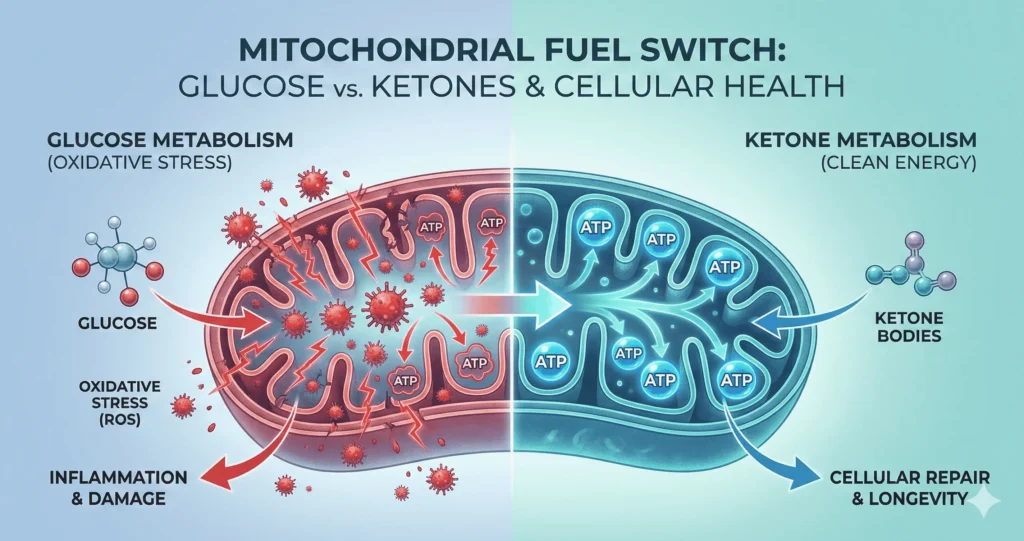
Mitochondria are your cells’ power plants. They convert fuel (glucose or ketones) into ATP—the energy currency your body uses for everything from thinking to moving.
When you eat carbs, glucose powers your mitochondria. When you’re in ketosis, ketones take over. The key difference? Ketones are a cleaner, more efficient fuel.
Why Ketones Give You More Energy Than Carbs
Here’s the science behind keto energy:
- Ketones produce less oxidative stress. When mitochondria burn glucose, they generate ATP but also create reactive oxygen species (ROS)—basically cellular exhaust that damages mitochondria over time. Ketones burn cleaner, producing the same ATP with less damage.
- Ketones increase mitochondrial biogenesis. Studies show ketones trigger the creation of NEW mitochondria. More mitochondria = more energy production capacity. This is why people report feeling more energized after keto adaptation—they literally have more cellular power plants.
- Ketones improve mitochondrial efficiency. Ketones activate proteins like PGC-1α that optimize mitochondrial function. Your cells get better at producing ATP, meaning you need less fuel to generate the same energy. This is why appetite drops on keto.
- Ketones stabilize blood sugar. On carbs, blood sugar spikes and crashes force your mitochondria to constantly adapt. Ketones provide steady, stable energy with no spikes or crashes. Your mitochondria can work at a consistent pace.
This is the real reason keto works for energy—not because carbs are “bad,” but because ketones allow your mitochondria to function optimally without the metabolic stress of glucose fluctuations.
If you’ve been struggling with fatigue and slow metabolism, check out our guide on repairing mitochondrial dysfunction for cellular energy optimization.
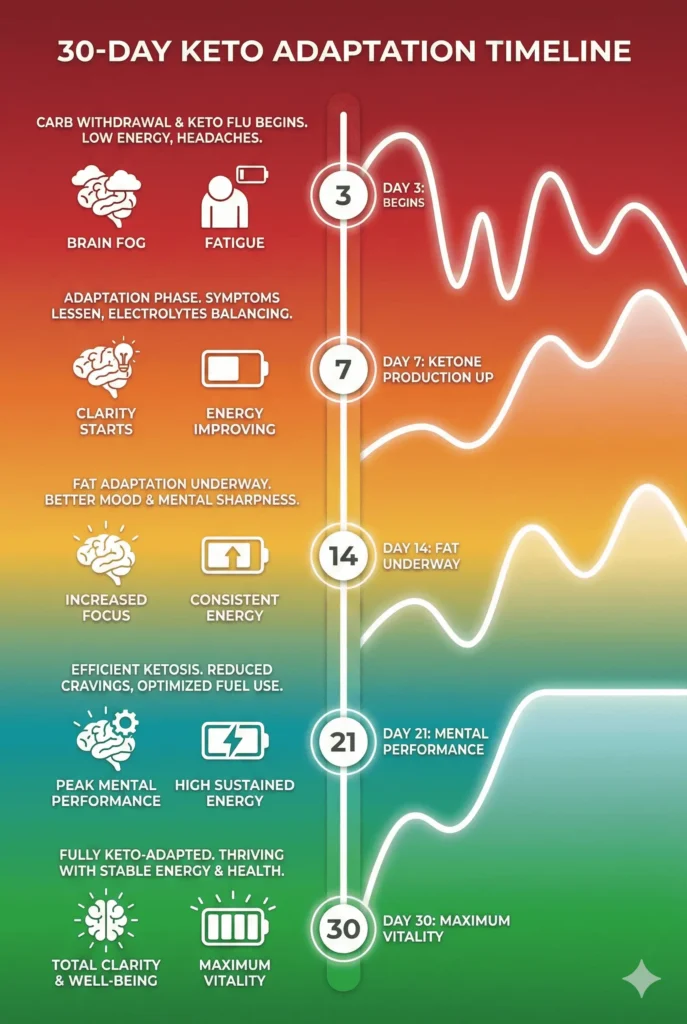
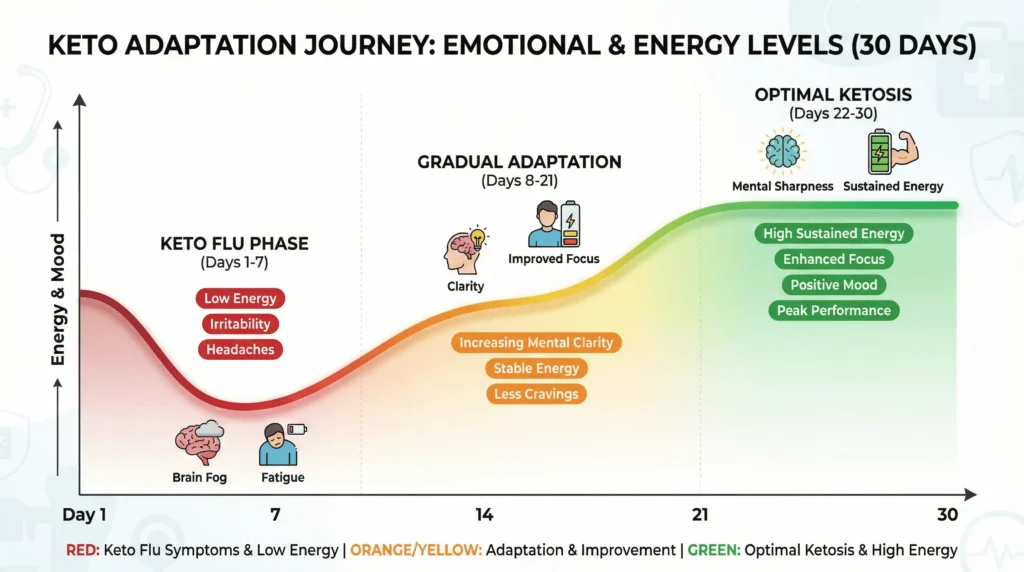
What Actually Happens When You Go Keto: The 30-Day Energy Timeline
Understanding how keto works requires knowing what happens during each phase of adaptation. Most people quit during the hardest phase before they reach the energy benefits.
Days 1-3: Glycogen Depletion (Keto Flu Begins)
Your body burns through stored glucose (glycogen). You feel tired, irritable, foggy. This is “keto flu”—not actually the flu, just your body panicking because its usual fuel is gone. Energy levels plummet because your mitochondria haven’t learned to use ketones efficiently yet.
What to do: Increase electrolytes aggressively (4,000-5,000mg sodium, 3,000mg potassium, 400mg magnesium). Most “keto flu” is actually electrolyte deficiency.
Days 4-7: Ketone Production Ramps Up
Your liver starts producing ketones. Some people feel better here; others still feel rough. Your mitochondria are learning to burn a new fuel. Keto energy isn’t consistent yet because ketone production fluctuates.
What to do: Keep carbs under 20g. Eat 70-75% calories from fat. Don’t quit—this is the hardest phase.
Days 8-14: Fat Adaptation Begins
Your cells start efficiently using ketones. Energy stabilizes. Mental clarity improves. Hunger decreases because ketones suppress appetite naturally. You’re entering the phase where keto gives you more energy than carbs did.
What to do: Maintain consistency. Add MCT oil to boost ketone production. Keep exercise light (walking, yoga).
Days 15-21: Stable Keto Energy
No more afternoon crashes. You can go hours without eating and feel fine. Fat adaptation is happening. Your mitochondria now prefer ketones over glucose. This is when most people think, “Oh, this actually works.”
Days 22-30: Full Mitochondrial Adaptation
You’re now “fat-adapted.” Mental sharpness, stable mood, consistent keto diet energy all day. Your mitochondria are efficiently burning ketones. Weight loss accelerates because your metabolism is optimized.
Critical point: Most people quit during days 1-7 because they feel terrible and assume keto “doesn’t work for them.” They never make it to ketosis. They’re stuck in metabolic limbo—not enough carbs to run on glucose, not enough time to produce ketones efficiently.
Learn how sleep quality affects keto adaptation.
Keto Energy vs Carb Energy: The Metabolic Difference
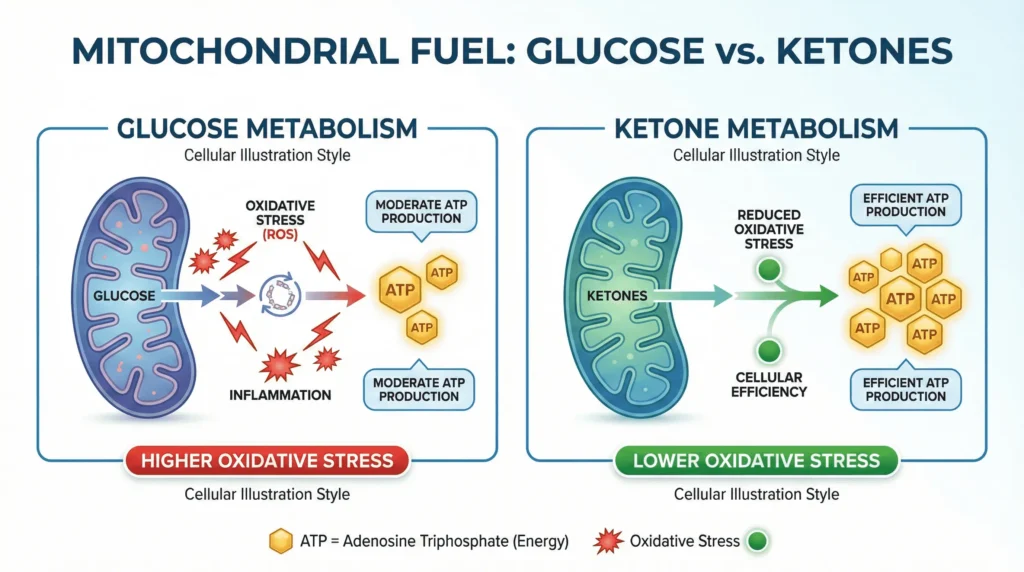
To understand why keto works for energy, you need to compare how your body processes glucose versus ketones.
How Carbs Fuel Your Body (Glucose Metabolism)
- Fast energy spike – Carbs convert to glucose quickly, giving immediate energy
- Insulin response – High glucose triggers insulin, which stores excess as fat
- Energy crashes – Blood sugar drops 2-3 hours after eating, causing fatigue
- Oxidative stress – Glucose metabolism produces more free radicals that damage mitochondria
- Constant hunger – Insulin spikes and crashes drive cravings every 2-4 hours
How Ketones Fuel Your Body (Ketone Metabolism)
- Sustained energy – Ketones provide steady fuel without spikes or crashes
- Low insulin – Minimal insulin response means easier fat burning
- Stable blood sugar – No energy crashes, consistent mental and physical performance
- Less oxidative stress – Ketones burn cleaner, protecting mitochondria
- Natural appetite suppression – Ketones suppress ghrelin (hunger hormone), making it easy to fast
This metabolic difference is why people report more energy on keto after adaptation. You’re running on premium fuel that doesn’t create the roller coaster of glucose metabolism.
Discover why mitochondria are key to burning stubborn fat.
Why Keto Fails for Some People (And How to Fix It)
If you tried keto and felt terrible the whole time, there’s usually a specific reason. It’s not that keto doesn’t work for you—it’s that something in your approach was off.
Problem #1: You Quit Before Adaptation
Most people bail during days 3-7 when they feel worst. You need 2-3 weeks minimum to adapt. If you quit early, you never get the keto energy benefits.
Fix: Commit to 30 days. Mark it on a calendar. The first week sucks, but it gets dramatically better.
Problem #2: You Didn’t Eat Enough Fat
Keto isn’t just “low carb.” It’s high fat, moderate protein, low carb. If you cut carbs but don’t replace them with fat, you’re just starving yourself. No wonder you felt terrible.
Fix: 70-75% of your calories should come from fat. Butter, olive oil, avocado, fatty fish, nuts. Don’t be scared of fat—it’s your new fuel source for keto diet energy.
Problem #3: Electrolyte Deficiency (The Real “Keto Flu”)
When you cut carbs, your body dumps water and electrolytes (sodium, potassium, magnesium). This causes “keto flu”—headaches, fatigue, muscle cramps, brain fog. It’s not ketosis—it’s dehydration.
Fix: Supplement electrolytes aggressively. 4,000-5,000mg sodium, 3,000-4,000mg potassium, 400mg magnesium daily. Add salt to everything. Drink bone broth. Check our morning hydration guide for protocols.
Problem #4: Your Mitochondria Were Already Damaged
If you’ve been eating processed food, under chronic stress, or sleep-deprived for years, your mitochondria are dysfunctional. Switching to keto won’t magically fix them overnight.
Fix: Combine keto with mitochondrial support—CoQ10, PQQ, magnesium. Read our mitochondrial health guide for the full protocol.
Problem #5: Too Much Protein (Hidden Carbs)
Excess protein converts to glucose through gluconeogenesis. If you’re eating 200g protein daily, you’re not really in ketosis—you’re just doing low-carb.
Fix: Keep protein moderate—about 20-25% of calories, or 0.8-1.0g per pound of lean body mass. More isn’t better on keto.
Problem #6: You Combined Keto with Intense Exercise Too Soon
Your muscles need time to adapt to burning fat instead of glucose. If you’re doing CrossFit or long runs during week one, you’ll feel like death and assume keto kills energy.
Fix: Keep exercise light the first 2-3 weeks. Walking, yoga, gentle strength training. Once adapted, you can ramp up intensity and actually have more energy on keto than you did on carbs.
The Best Foods for Keto Energy and Mitochondrial Health
Not all keto foods are equal. You can technically stay in ketosis eating bacon and butter all day, but your mitochondria won’t thrive. For optimal keto energy, prioritize these foods:
Top Keto Foods for Energy:
- Fatty fish (salmon, mackerel, sardines): High in omega-3s, which support mitochondrial membrane health and reduce inflammation. Essential for sustained keto diet energy.
- Avocados: Loaded with healthy fats, potassium (critical on keto), and fiber. One of the best keto foods for overall mitochondrial health.
- Leafy greens (spinach, kale, arugula): Low-carb, high in magnesium and antioxidants. Protect mitochondria from oxidative stress.
- Nuts and seeds (macadamia, walnuts, chia, flax): Healthy fats, magnesium, fiber. Walnuts are particularly high in omega-3s for brain energy.
- Olive oil and coconut oil: Primary fat sources. Coconut oil contains MCT (medium-chain triglycerides), which convert to ketones quickly for instant keto energy.
- Eggs: Perfect keto food. High in choline (supports mitochondria) and easily absorbed protein.
- Grass-fed meat and organ meats: Quality matters. Liver is especially rich in CoQ10, a critical mitochondrial nutrient.
- Low-carb vegetables (broccoli, cauliflower, zucchini, bell peppers): Fiber, vitamins, antioxidants. Keep your gut healthy while maintaining ketosis.
Minimize These (Even Though They’re “Keto”):
- Processed keto snacks (bars, cookies, shakes) – Inflammatory ingredients
- Excessive dairy – Can cause inflammation in some people
- Seed oils (canola, soybean, corn oil) – Damage mitochondria
- Artificial sweeteners – May affect gut health and insulin response
Focus on whole foods. The closer you get to “real food,” the better your mitochondria function and the more consistent your keto energy levels.
Learn the best keto breakfast ideas for sustained energy.
Supplements That Boost Keto Energy and Mitochondrial Function
Keto alone helps mitochondria. Adding specific supplements amplifies the effect and accelerates your keto energy adaptation.
Essential Keto Supplements for Energy:
- Electrolytes (sodium, potassium, magnesium): Non-negotiable. Prevents keto flu, supports energy production, keeps mitochondria functioning. Take magnesium glycinate (400mg) before bed and add salt liberally to meals.
- MCT oil: Converts directly to ketones, bypassing normal digestion. Great for boosting keto energy quickly, especially when fasting. Start with 1 tsp and work up to 1-2 tbsp daily.
- CoQ10: Directly involved in mitochondrial ATP production. Levels decline with age. Supplementing (100-200mg daily) enhances mitochondrial efficiency on keto.
- Omega-3 (fish oil or algae oil): Reduces inflammation, supports mitochondrial membranes. 1,000-2,000mg EPA+DHA daily for optimal keto diet energy.
- Creatine: Not just for muscle. Supports ATP production in mitochondria. 5g daily. Works synergistically with keto for sustained energy.
- Alpha-lipoic acid (ALA): Antioxidant that protects mitochondria and improves insulin sensitivity. 300-600mg daily.
I don’t take all of these every day, but I cycle through them. Electrolytes and magnesium are daily. CoQ10 and omega-3 are daily. MCT oil and creatine are 4-5 days per week for maximum keto energy benefits.
Keto + Intermittent Fasting: The Ultimate Energy Protocol
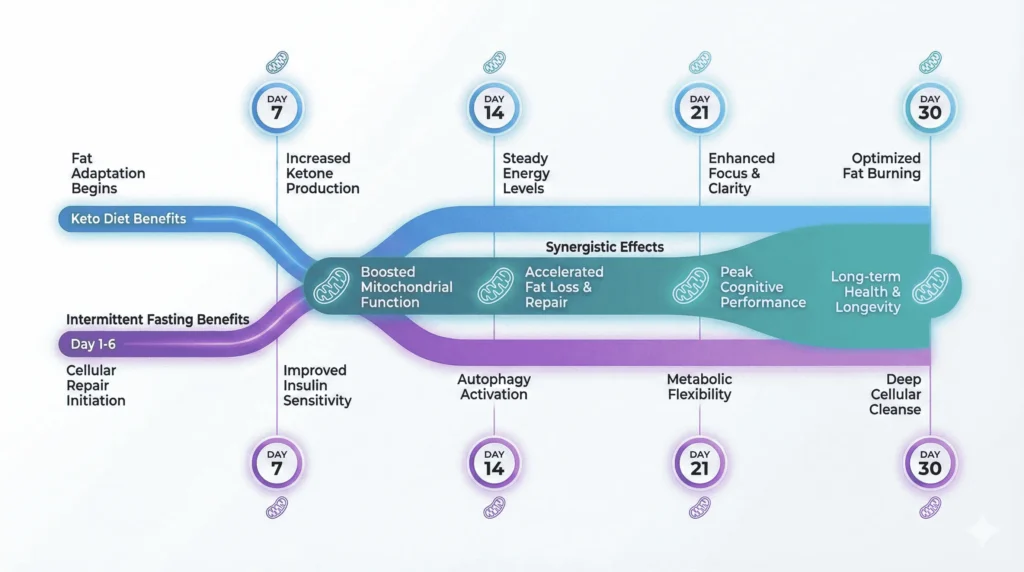
Here’s where it gets powerful. Keto works for energy on its own. Intermittent fasting triggers mitochondrial repair through autophagy. Combined? They’re synergistic.
Why They Work Together:
When you’re in ketosis, your body is already fat-adapted. Adding intermittent fasting extends the time your mitochondria spend in “cleanup mode.” Instead of constantly processing food, they focus on repairing damage and creating new mitochondria.
Fasting also increases ketone production. A 16-hour fast can push your ketone levels higher than they’d be just from eating keto. More ketones = more mitochondrial benefits = more sustained keto energy.
My Protocol for Maximum Keto Energy:
I do 16:8 intermittent fasting while on keto. I eat between noon and 8 PM. First meal is high-fat, moderate protein—usually eggs, avocado, and vegetables. Dinner is similar. No snacking between meals.
This gives me 16 hours of fasting (with ketone production peaking) and 8 hours to eat enough calories and fat to stay energized.
Important: If you’re new to both, don’t start them simultaneously. Get fat-adapted on keto first (2-3 weeks), then introduce fasting. Learn more about intermittent fasting and cellular repair for the complete protocol.
Common Keto Mistakes That Kill Energy Benefits
Even when following keto “correctly,” these mistakes can sabotage your keto energy levels:
- Eating “dirty keto.” Staying in ketosis by eating fast food burgers (no bun) and processed cheese. Technically keto, but seed oils and inflammatory ingredients damage mitochondria. Stick to whole foods for sustained keto diet energy.
- Not tracking macros. You think you’re eating 20g carbs, but it’s actually 60g because you’re not measuring. Hidden carbs kick you out of ketosis. Track for the first month.
- Overeating protein. More protein doesn’t mean more muscle or faster weight loss. Excess protein converts to glucose and kicks you out of ketosis. Stick to moderate protein (20-25% of calories).
- Under-eating calories. Keto suppresses appetite, but some people eat only 1,000 calories daily. Your metabolism will crash and keto energy will plummet. Eat enough fat to sustain energy.
- Ignoring sleep and stress. Keto helps mitochondria, but chronic stress and poor sleep destroy them. If you’re sleeping 5 hours and stressed 24/7, keto won’t save you. Fix your sleep habits first.
- Staying on strict keto forever. Some people thrive long-term. Others need occasional carb refeeds for hormone balance. Listen to your body. If you feel run-down after 6 months, try cyclical keto.
Learn how stress sabotages keto results.
Who Should (and Shouldn’t) Try Keto for Energy
Keto isn’t for everyone. Here’s who benefits most from keto energy optimization:
Good Candidates for Keto:
- People with insulin resistance or prediabetes
- Those with stubborn weight that won’t budge
- Anyone dealing with chronic fatigue or brain fog
- People who do well with structure and rules
- Those interested in optimizing mitochondrial function for sustained keto diet energy
Not Ideal For:
- People with eating disorders or disordered eating history
- Pregnant or breastfeeding women
- Type 1 diabetics (without medical supervision)
- Those with kidney issues
- People who feel terrible even after 4+ weeks (some genuinely don’t adapt well)
If you have any medical conditions, talk to a doctor before starting keto. Especially if you’re on medications for diabetes, blood pressure, or thyroid—keto can change how these work.
My Results After 8 Months on Keto
I stayed on strict keto for about 6 months, then transitioned to cyclical keto (keto 5 days, moderate carbs 2 days). Here’s what changed:
- Weight: Lost 26 pounds, mostly from midsection. Body composition improved significantly—more muscle definition without trying.
- Keto energy: This was the biggest win. Stable energy all day. No 2 PM crash. I can work 6-8 hours without feeling exhausted. More energy on keto than I ever had on carbs.
- Mental clarity: Sharper focus. Better memory. Less brain fog. This alone made keto worth it.
- Hunger: Not constantly thinking about food anymore. I eat when hungry, stop when full. Sugar cravings disappeared after week 3.
- Sleep: Deeper, more restorative sleep. Wake up feeling refreshed instead of groggy.
- Blood markers: Fasting glucose dropped from 96 to 84. Triglycerides dropped significantly. HDL (good cholesterol) increased.
- Exercise performance: Took a hit initially, but after 6 weeks I was stronger and had better endurance than before keto. Sustained keto diet energy during workouts without crashes.
Keto isn’t magic, but when done correctly—with a focus on mitochondrial health—it’s one of the most effective metabolic interventions for sustained energy.
Discover why exhaustion blocks weight loss.
Frequently Asked Questions About Keto and Energy
Why do I have more energy on keto than on carbs?
Ketones fuel your mitochondria more efficiently than glucose, producing the same ATP with less oxidative stress. They also stabilize blood sugar, eliminating the energy crashes caused by insulin spikes. Once fat-adapted (2-3 weeks), most people experience sustained keto energy throughout the day without afternoon crashes.
Will keto slow down my metabolism?
No. Short-term studies show keto either maintains or slightly increases metabolic rate. The key is eating enough calories and not staying in a severe deficit for months. Keto shifts your body to burn fat more efficiently, which improves metabolic flexibility long-term and supports consistent keto diet energy.
How long does it take to feel energized on keto?
Most people notice improved keto energy between days 8-14 as ketone production stabilizes. Full energy benefits typically appear by days 22-30 once you’re fully fat-adapted. The first week is the hardest—you’ll feel worse before you feel better as your body transitions from glucose to ketones.
Can I build muscle on keto?
Yes, but it requires adequate protein (0.8-1.0g per pound of lean body mass) and consistent strength training. Some people do better on targeted ketogenic diet (TKD)—small amounts of carbs around workouts. Keto energy for exercise improves significantly after 4-6 weeks of adaptation.
What if I have high cholesterol on keto?
Keto often increases total cholesterol and LDL, but usually shifts LDL particles to the larger, less harmful type. Triglycerides typically drop significantly, and HDL (good cholesterol) increases. Get a full lipid panel, not just total cholesterol. If you have familial hypercholesterolemia or heart disease, work with a doctor.
How do I know if I’m in ketosis?
The most reliable way is testing blood ketones with a meter (0.5-3.0 mmol/L indicates ketosis). Subjective signs of ketosis include: reduced hunger, steady keto energy without crashes, mental clarity, and sometimes a “fruity” breath smell. Urine strips work initially but become unreliable after adaptation.
Can I drink alcohol on keto?
Technically yes—dry wine, spirits (vodka, whiskey, tequila) have zero carbs. But alcohol pauses ketosis temporarily because your liver prioritizes metabolizing alcohol over producing ketones. It also lowers inhibitions, making it easier to break your diet and lose your keto energy momentum. If you drink, keep it minimal.
What if I accidentally eat carbs?
You’ll get kicked out of ketosis temporarily and may lose some keto energy for 24-48 hours. It’s not a disaster. Just get back on track with your next meal. Don’t try to “compensate” by fasting excessively—that creates an unhealthy cycle. One meal won’t ruin weeks of progress.
Is keto safe long-term?
For most people, yes. Some thrive on keto indefinitely with sustained keto diet energy. Others do better with cyclical keto (strict during the week, moderate carbs on weekends). Listen to your body. If you feel great after a year, keep going. If you feel run-down, experiment with adding carbs back strategically.
Final Thoughts on Keto and Energy
Keto works for energy—but only if you understand WHY it works. It’s not about “carbs are bad.” It’s about giving your mitochondria a cleaner, more efficient fuel source that allows them to function optimally without the oxidative stress and blood sugar chaos of glucose metabolism.
If you’ve tried keto before and quit because you felt terrible, you probably didn’t make it past the adaptation phase. Or you made common mistakes—too little fat, not enough electrolytes, too much protein, exercising too intensely too soon.
This time, approach it differently:
- Focus on supporting your mitochondria with quality foods and supplements
- Commit to 30 days minimum before judging results
- Supplement electrolytes aggressively to avoid “keto flu”
- Keep exercise light the first 2-3 weeks
- Eat enough fat (70-75% of calories)
- Track macros the first month
After the first two weeks, you’ll either feel amazing with sustained keto energy or know that keto genuinely doesn’t work for your body. But you won’t know unless you do it right.
If you’re serious about optimizing cellular energy, combine keto with strategies in our mitochondrial health guide and consider adding intermittent fasting once you’re adapted.
Your mitochondria—and your keto energy levels—will thank you.

Elena Hartwell is a wellness educator specializing in sleep optimization, metabolic health, and natural weight management. After years of struggling with exhaustion and unexplained weight gain despite “doing everything right,” Elena discovered the powerful connection between sleep quality, gut health, and metabolism—a breakthrough that transformed her life and inspired her mission. Today, she translates cutting-edge research into simple, actionable strategies that help readers sleep better, lose stubborn weight naturally, and reclaim their energy. Elena’s evidence-based approach has helped thousands break free from the diet-exercise cycle by addressing the root cause: disrupted sleep and metabolic dysfunction.