Doctors say it’s calories. Trainers blame your discipline. But nobody mentions the hidden mechanism sabotaging your efforts every single night while you sleep.
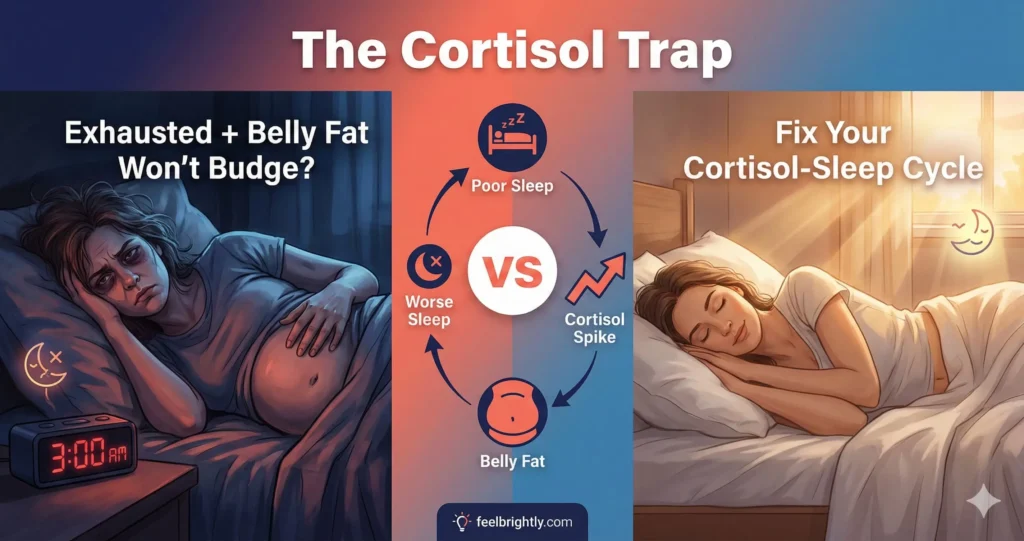
Here’s the truth: Poor sleep quality triggers a cortisol surge that locks belly fat in place and makes you store MORE fat the next day—creating a vicious cycle you can’t escape.
The Sleep-Cortisol-Belly Fat Connection Nobody Talks About
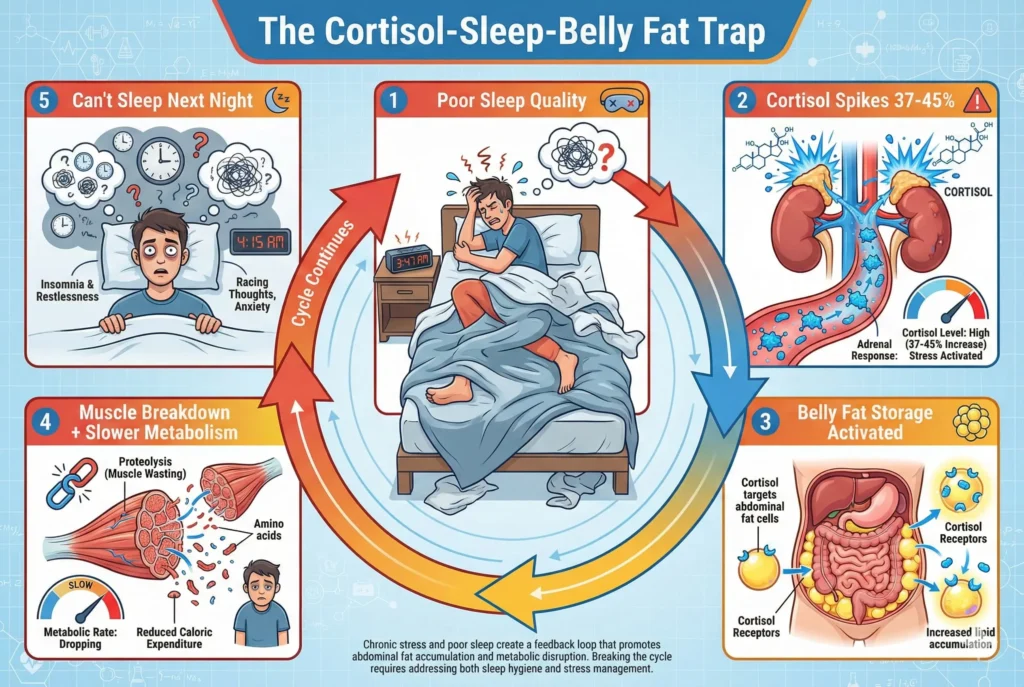
Stanford University researchers discovered something shocking: when you don’t get quality sleep, your cortisol levels spike by 37-45% the very next evening—right when they should be lowest.
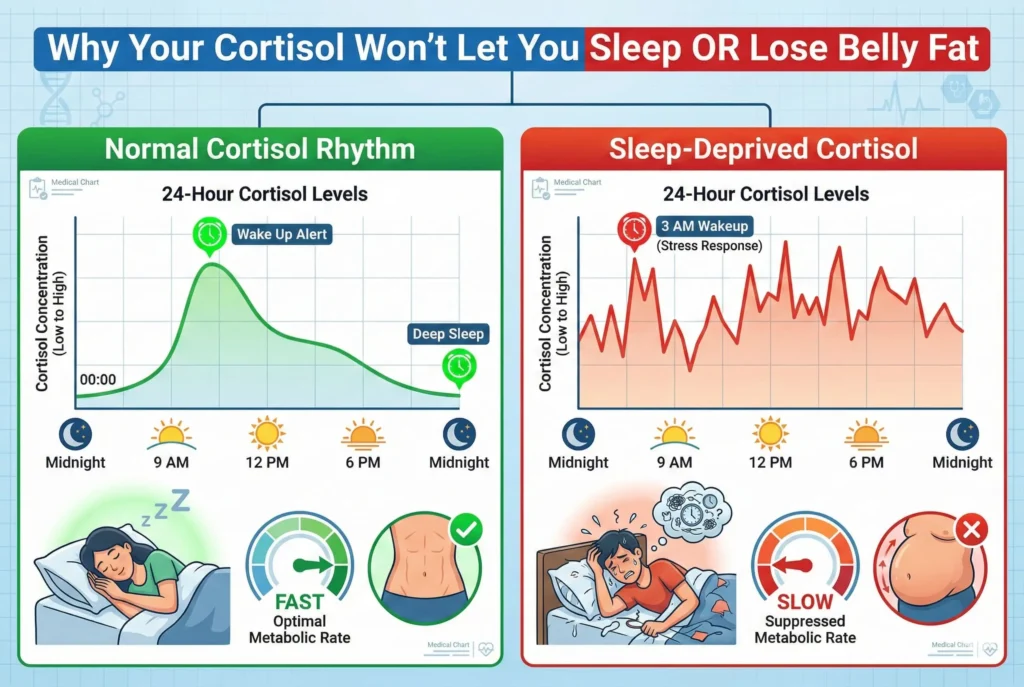
Cortisol is your body’s stress hormone. Normally, it peaks around 9 AM to wake you up, then gradually decreases throughout the day. By evening, it should be at its lowest, allowing you to relax and sleep deeply.
But poor sleep disrupts this natural rhythm completely.
What Happens in Your Body When Sleep Quality Drops
When you sleep poorly—whether it’s tossing and turning, waking up frequently, or never reaching deep sleep—your body interprets this as a major stressor.
Your adrenal glands respond by flooding your system with cortisol. Instead of peaking only in the morning, cortisol stays elevated all day and surges again at night. Learn why poor sleep quality leaves you exhausted all day.
This creates four catastrophic problems:
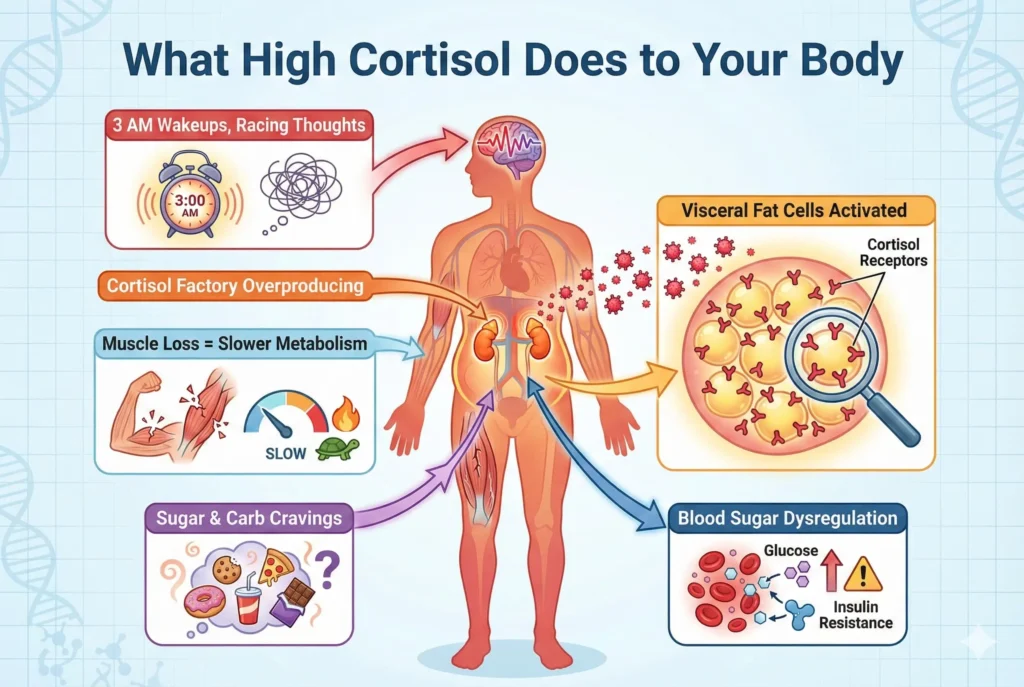
- Your body switches to “fat storage mode” – High cortisol signals your body that you’re under threat. It responds by storing every calorie as belly fat to protect vital organs
- You lose muscle instead of fat – Elevated cortisol breaks down muscle tissue for energy, slowing your metabolism even further
- Insulin resistance develops – Chronic cortisol causes insulin to stop working properly, meaning carbs get stored as fat instead of burned for energy
- You can’t sleep the next night either – High evening cortisol prevents deep sleep, perpetuating the cycle
You’re trapped in a metabolic prison. Discover why exhaustion makes weight loss impossible.
Why Cortisol ONLY Stores Fat Around Your Belly
Not all fat is created equal. Your body has two types: subcutaneous fat (under the skin) and visceral fat (deep belly fat surrounding organs).
Here’s what makes belly fat unique: visceral fat cells have MORE cortisol receptors than any other fat cells in your body.
When cortisol floods your system, it doesn’t distribute fat evenly. It targets your belly specifically because those fat cells are primed to respond. This is why you can have slim arms and legs but a belly that won’t shrink. Learn why belly fat is the hardest to lose.
The Midnight Cortisol Surge That Packs On Pounds
Research shows that sleep-deprived people experience a cortisol spike between midnight and 3 AM—exactly when cortisol should be at its absolute lowest.
This midnight surge does three devastating things:
- Triggers 3 AM wakeups – High cortisol jolts you awake, often with anxiety or a racing heart
- Prevents deep sleep stages – You never reach the restorative sleep phases where fat burning happens naturally
- Activates next-morning cravings – The cortisol-insulin disruption makes you crave sugar and carbs the moment you wake up
You wake up more exhausted than when you went to bed. Understand why you crave sugar constantly when exhausted.
Why Dieting Makes It WORSE When Cortisol Is High
Here’s the cruel irony: when you restrict calories to lose belly fat, your body perceives the caloric deficit as ANOTHER stressor.
If you’re already sleep-deprived with elevated cortisol, adding diet-induced stress compounds the problem exponentially.
What Happens When You Diet with High Cortisol
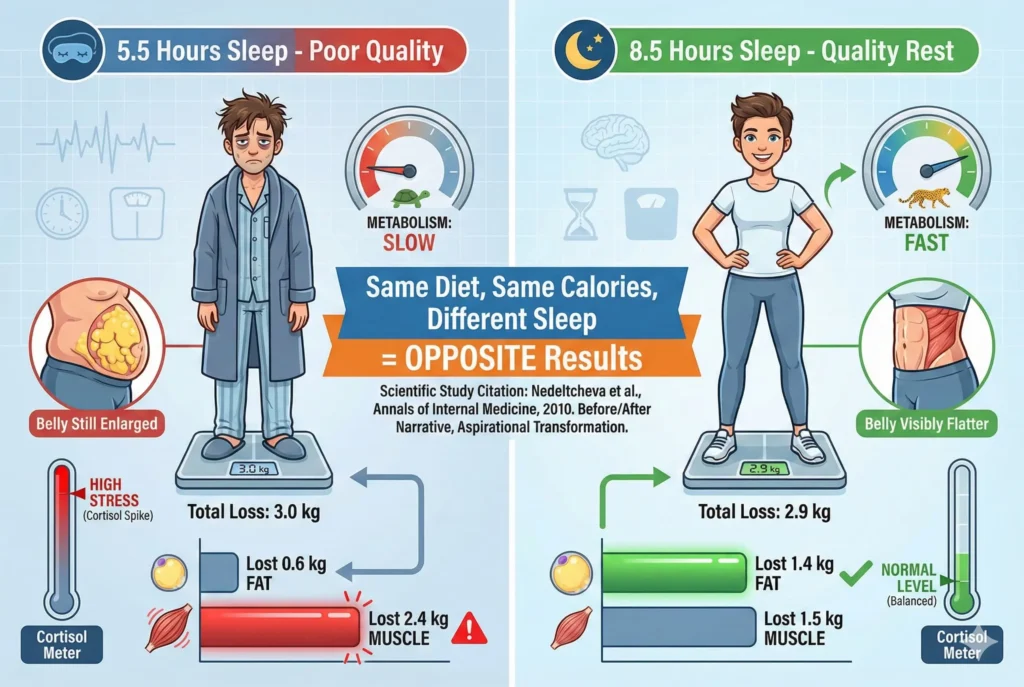
A groundbreaking study found that sleep-deprived dieters who got only 5.5 hours of sleep lost 2.4 kg of muscle but only 0.6 kg of fat. Meanwhile, those who slept 8.5 hours lost 1.4 kg of fat and only 1.5 kg of muscle.
Same diet. Same calorie deficit. Completely different results—all because of sleep quality and cortisol levels.
High cortisol during dieting causes:
- Accelerated muscle breakdown (slower metabolism)
- Increased hunger hormones (ghrelin spikes by 28%)
- Decreased fullness hormones (leptin drops by 18%)
- Enhanced fat storage despite eating less
This explains why 70% of people who fail weight loss programs have unaddressed chronic sleep problems. Learn why you might be gaining weight overnight.
How to Break the Cortisol-Sleep-Belly Fat Cycle
You can’t out-diet or out-exercise chronically elevated cortisol. The ONLY solution is to fix the root cause: sleep quality.
The 3-Step Cortisol Reset
Step 1: Lower Evening Cortisol Naturally
Your goal is to help cortisol drop in the evening so deep sleep becomes possible:
- Stop caffeine after 2 PM (caffeine elevates cortisol 6-8 hours later)
- Dim lights after 8 PM (bright light signals cortisol production)
- Practice 10 minutes of deep breathing before bed (reduces cortisol by 12% within 4 weeks)
- Keep bedroom temperature 65-68°F (cool temps help cortisol decline)
Step 2: Achieve Deep Sleep Stages
Deep sleep is where overnight fat burning happens and cortisol normalizes:
- Block out ALL light (even phone charging lights disrupt cortisol rhythm)
- Use white noise or earplugs (sleep disruptions spike cortisol immediately)
- Consistent 10:30 PM bedtime (trains cortisol to drop at the same time nightly)
- Magnesium glycinate 400mg before bed (supports cortisol regulation and deep sleep)
Step 3: Support Daytime Cortisol Balance
Managing stress during the day prevents evening cortisol surges:
- Morning sunlight within 30 minutes of waking (sets healthy cortisol rhythm)
- Moderate exercise (intense workouts spike cortisol when you’re already stressed)
- Protein-rich breakfast (stabilizes blood sugar and prevents cortisol spikes)
- 20-minute nature walk daily (lowers cortisol 8-10% within 2 weeks)
Try this 5-minute morning routine to balance cortisol naturally.
What Happens When You Fix Your Sleep-Cortisol Cycle
Within 2-4 weeks of improving sleep quality and lowering cortisol:
- Week 1-2: Morning energy improves, 3 AM wakeups stop, sugar cravings decrease
- Week 2-4: Belly feels less puffy and bloated, hunger normalizes, mood stabilizes
- Week 4-8: Belly fat starts reducing noticeably, clothes fit looser around waist
- Week 8-12: 5-12 lbs lost (mostly from midsection), sleep quality deeply restorative
You’re not fighting your hormones anymore. Your body is finally working WITH you instead of against you. Also learn how gut bacteria affect weight loss.
Real Results from Cortisol Reset
Sarah, 44: “I didn’t realize poor sleep was causing my belly fat. Within 3 weeks of sleeping better, I lost 9 pounds—all from my stomach. The constant exhaustion is gone too.”
Michael, 52: “I’ve been dieting for years with zero results. Two months of fixing my sleep quality and I’ve lost 15 pounds. My doctor says my cortisol levels are finally normal.”
The Bottom Line
You can’t out-diet elevated cortisol. You can’t out-exercise disrupted sleep. Poor sleep quality triggers cortisol surges that lock belly fat in place, break down muscle, and make you gain MORE weight the next day.
The only sustainable solution is fixing sleep quality FIRST. When cortisol normalizes, belly fat melts off naturally—no restrictive diets, no punishing workouts, no willpower required.
Your body knows how to burn belly fat. It’s been trying to. But chronically elevated cortisol from poor sleep has been blocking it every single night.
Fix your sleep. Reset your cortisol. Watch the belly fat disappear.
Frequently Asked Questions
Can poor sleep really cause belly fat?
Yes. Stanford research shows sleep deprivation spikes cortisol by 37-45%, which directly signals your body to store visceral belly fat. Belly fat cells have more cortisol receptors than any other fat cells, making them uniquely responsive to elevated cortisol from poor sleep.
How do I know if cortisol is causing my belly fat?
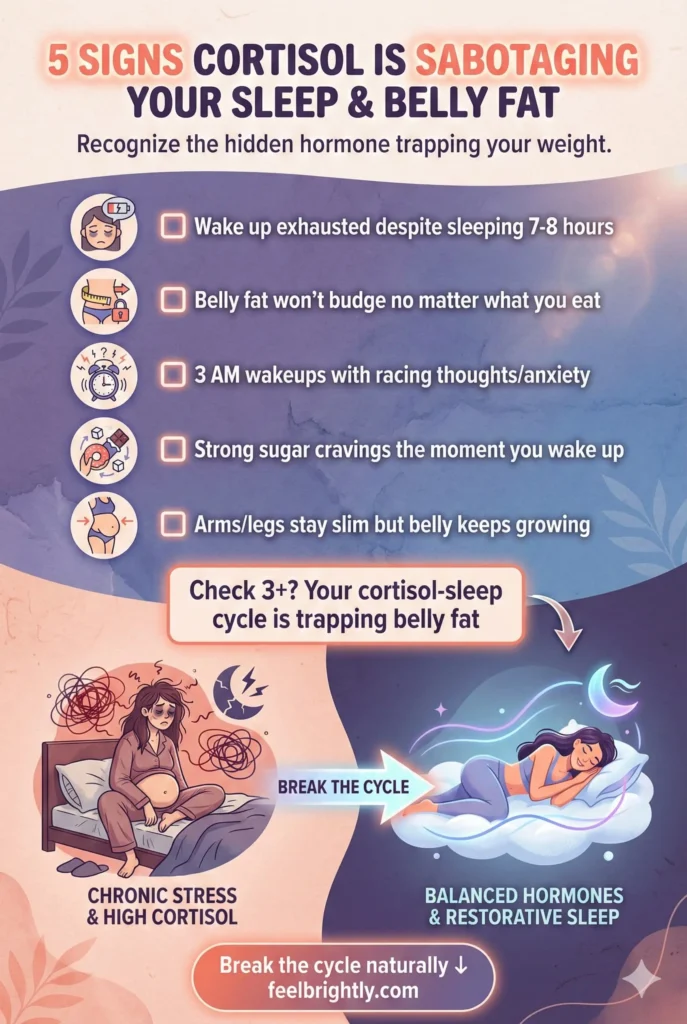
Signs include: waking up exhausted despite sleeping 7-8 hours, 3 AM wakeups, inability to lose belly fat despite diet/exercise, strong morning sugar cravings, gaining weight around midsection only while arms/legs stay slim, and feeling “wired but tired” at night.
How long until cortisol normalizes with better sleep?
Cortisol rhythm begins improving within 4-7 days of consistent quality sleep. Noticeable belly fat reduction typically occurs within 4-8 weeks as cortisol levels stabilize and insulin sensitivity improves. Research shows full cortisol reset takes 8-12 weeks.
Can I lower cortisol without sleeping pills?
Yes. Natural cortisol-lowering strategies include: magnesium glycinate before bed, evening relaxation techniques (deep breathing reduces cortisol 12% in 4 weeks), consistent sleep schedule, morning sunlight exposure, and stress management during the day. These normalize cortisol without medication.
Why does cortisol only affect belly fat and not other areas?
Visceral belly fat cells have 4x more cortisol receptors than subcutaneous fat cells elsewhere. When cortisol levels are high, it specifically targets and enlarges belly fat cells while leaving other areas relatively unchanged. This is why stressed, sleep-deprived people develop “cortisol belly” patterns.
Will losing weight help me sleep better?
It depends. If belly fat is causing sleep issues (like sleep apnea), weight loss helps. But if poor sleep CAUSED the weight gain through cortisol dysregulation, you must fix sleep quality FIRST before weight loss becomes possible. 70% of failed weight loss attempts have unaddressed sleep problems.

Elena Hartwell is a wellness educator specializing in sleep optimization, metabolic health, and natural weight management. After years of struggling with exhaustion and unexplained weight gain despite “doing everything right,” Elena discovered the powerful connection between sleep quality, gut health, and metabolism—a breakthrough that transformed her life and inspired her mission. Today, she translates cutting-edge research into simple, actionable strategies that help readers sleep better, lose stubborn weight naturally, and reclaim their energy. Elena’s evidence-based approach has helped thousands break free from the diet-exercise cycle by addressing the root cause: disrupted sleep and metabolic dysfunction.