I tried intermittent fasting three years ago because everyone on the internet said it was magic for weight loss.
This time, intermittent fasting actually worked—and kept working. I’ve been doing 16:8 for over a year now. My energy is stable all day, I’m not constantly hungry, and my body composition changed without obsessing over calories.
But here’s what made the biggest difference: I stopped treating fasting like a diet restriction and started treating it like cellular maintenance.
This guide explains why intermittent fasting works at the cellular level, how it repairs mitochondria, and the protocol that actually sticks long-term—including the metabolic optimization strategy that amplified my results.
🔥 Fasting Works—But This Metabolic Loophole Makes It Work Faster
Autophagy is powerful. But when you activate the metabolic pathways most people ignore, cellular repair accelerates, fat loss doubles, and energy stays high—even during extended fasts.
Disclosure: Affiliate link. I may earn a commission at no extra cost to you.
What Intermittent Fasting Actually Does to Your Cells
Most people think intermittent fasting is just “skipping breakfast to eat less calories.” That’s not wrong, but it misses the entire point.
The real benefit of fasting happens at the cellular level. When you stop eating for 12-16 hours, your body shifts into a different metabolic state. Instead of constantly processing new food, it starts cleaning house.
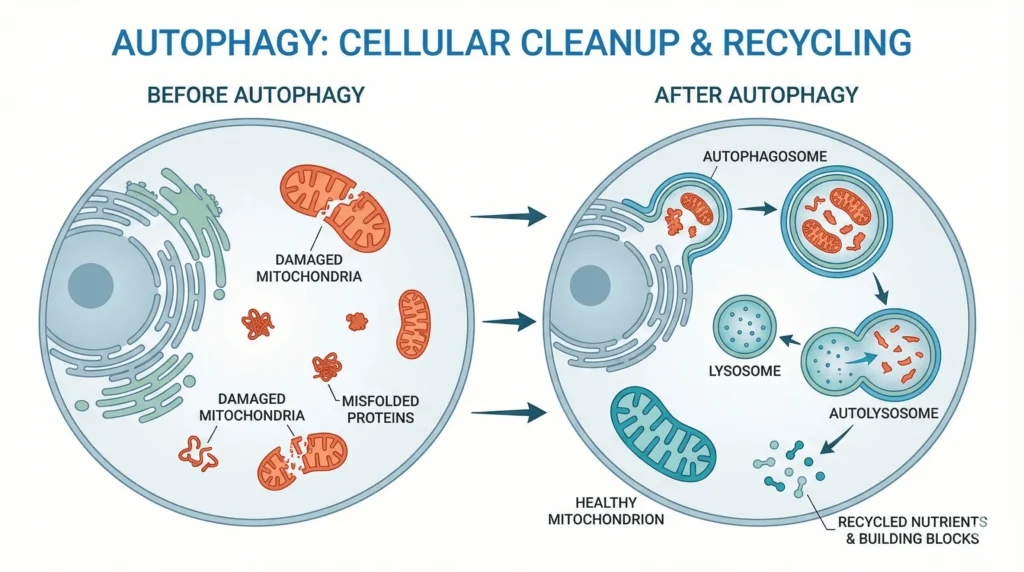
This process is called autophagy—literally “self-eating.” Your cells start breaking down and recycling damaged components, including old mitochondria, misfolded proteins, and cellular debris that’s been building up.
Think of it like this: If you’re constantly eating, your body is in “building mode.” It’s processing nutrients, storing energy, growing new cells. That’s fine, but there’s never time for maintenance.
Fasting puts your body in “repair mode.” It’s like finally having time to clean your house instead of just throwing more stuff in it.
What Happens During a Fast
Hours 0-4:Digesting your last meal, blood sugar dropping
Hours 4-8:Glycogen stores depleting, insulin levels falling
Hours 8-12:Body starts shifting to fat burning
Hours 12-16:Autophagy kicks in, cellular cleanup accelerates
Hours 16+:Peak fat burning, maximum cellular repair
The sweet spot for most people is 14-16 hours. That’s when autophagy really ramps up and your mitochondria start getting replaced with fresh, functional ones.
How Fasting Repairs Your Mitochondria
Remember how I talked about mitochondrial dysfunction causing weight gain and fatigue? Fasting is one of the most powerful ways to reverse that damage.
Here’s what happens to your mitochondria during a fast:
1. Mitophagy (Mitochondrial Autophagy)
Old, damaged mitochondria get broken down and recycled. This is critical because dysfunctional mitochondria produce more harmful free radicals than energy. Getting rid of them is like removing the weakest links from a chain.
2. Mitochondrial Biogenesis
After cleaning out the junk, your body creates new, healthy mitochondria. Fasting triggers the activation of PGC-1α, a protein that tells your cells to build more mitochondria. More mitochondria = more energy production capacity.
3. Improved Metabolic Flexibility
When you’re constantly eating, your body relies on glucose for energy. Fasting forces your body to switch to burning fat. This “metabolic flexibility”—the ability to easily switch between fuel sources—is a sign of healthy mitochondria.
4. Reduced Oxidative Stress
Eating constantly, especially processed foods, creates oxidative stress that damages mitochondria. Fasting gives your cells a break from this damage and allows antioxidant systems to catch up.
5. Enhanced Insulin Sensitivity
Fasting lowers insulin levels, which improves how efficiently your cells use energy. Better insulin sensitivity means your mitochondria don’t have to work as hard to process nutrients.
This is why fasting feels different than just eating less. You’re not just reducing calories—you’re fundamentally changing how your cells produce energy.
The Different Fasting Protocols (And Which One to Start With)
There’s no “one size fits all” fasting protocol. Here’s what actually works for different situations:
16:8 Method (Fast 16 hours, eat 8 hours)
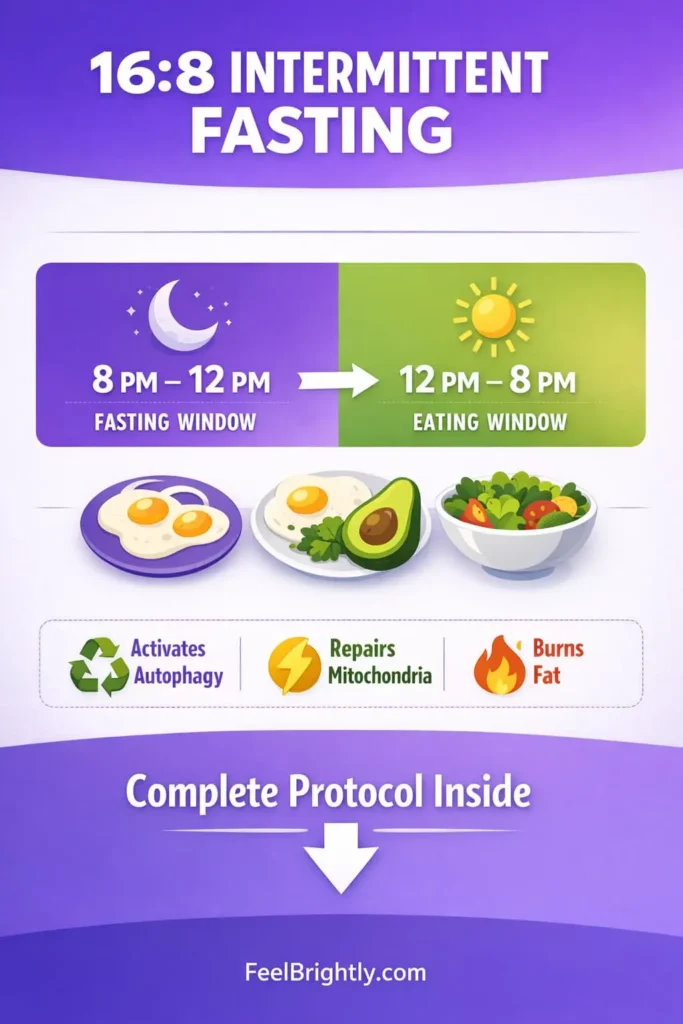
This is where I started and what I still do. You eat all your meals within an 8-hour window—usually noon to 8 PM or 10 AM to 6 PM.
- Pros: Easy to stick with, fits normal social schedules, enough time to get autophagy benefits
- Cons: Still requires some discipline in the morning
- Best for: Beginners, people with normal work schedules
14:10 Method (Fast 14 hours, eat 10 hours)
A gentler version. Eat from 8 AM to 6 PM.
- Pros: Easier to start, less hunger, good for women (who may need shorter fasts)
- Cons: Less time in deep autophagy
- Best for: Complete beginners, people with hormone sensitivity
18:6 Method (Fast 18 hours, eat 6 hours)
More aggressive. Eat from noon to 6 PM or 2 PM to 8 PM.
- Pros: Deeper autophagy, stronger metabolic benefits
- Cons: Harder to sustain, can affect social life
- Best for: Experienced fasters, people with specific health goals
5:2 Diet (Normal eating 5 days, restricted 2 days)
Eat normally five days a week, restrict to 500-600 calories on two non-consecutive days.
- Pros: Don’t have to fast every day, flexibility
- Cons: Two days of feeling terrible, harder to build routine
- Best for: People who hate daily fasting windows
OMAD (One Meal A Day)
Fast 23 hours, eat one large meal.
- Pros: Maximum autophagy, simplest eating pattern
- Cons: Very difficult, can be hard to get enough nutrients, socially isolating
- Best for: Advanced fasters only, not recommended for most people
My recommendation: Start with 14:10 for two weeks. Then move to 16:8. Stay there for at least 3 months before considering anything more aggressive.
Don’t jump straight into 18:6 or OMAD. You’ll hate it, quit, and decide fasting “doesn’t work for you.” Build the habit first.
🎯 The Missing Piece Most Fasters Overlook
You’re doing 16:8 correctly. But without strategic metabolic activation, you’re leaving 50% of results on the table. This is the exact protocol that turned my plateau into progress.
Affiliate disclosure: I may earn a commission at no extra cost to you.
How I Actually Do 16:8 (The Real Protocol)
Here’s my exact daily routine. This is what made fasting sustainable for me after failing the first time.
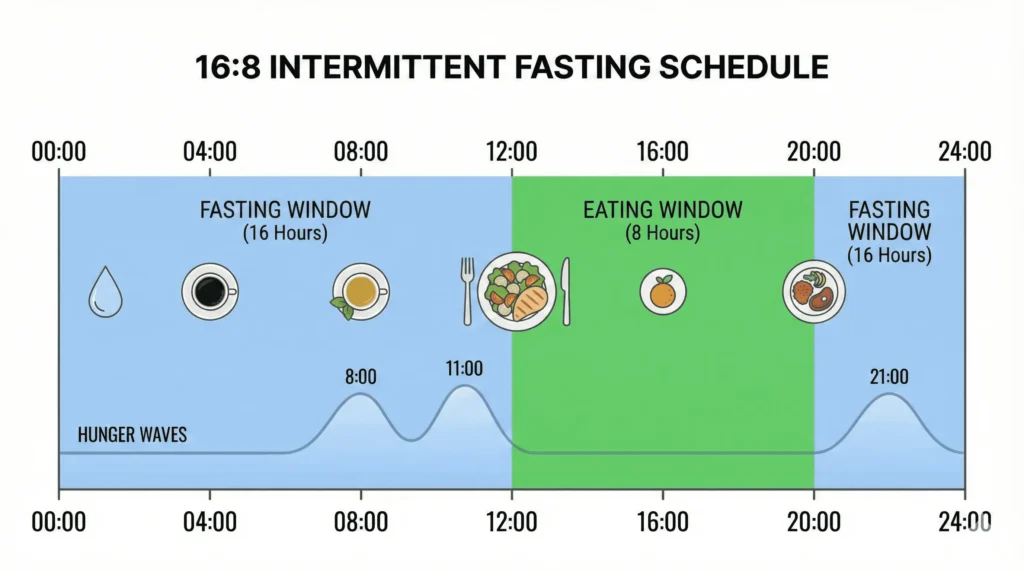
Evening (7-8 PM): Last meal
I eat dinner with my family. Nothing special—just regular food. I finish eating by 8 PM.
8 PM – Bedtime: No snacking
This was hard at first because I used to eat while watching TV. Now I drink herbal tea or sparkling water if I want something.
Morning (6-7 AM): Wake up, drink water
Lots of it. Sometimes I add a pinch of sea salt for electrolytes. This kills most hunger. I also have black coffee—no cream, no sugar. Coffee actually enhances autophagy and makes fasting easier.
Mid-morning (10-11 AM): Hunger wave
This is when hunger usually hits. I drink more water, black coffee, or green tea. The hunger passes in 15-20 minutes. It’s not constant—it comes in waves.
Noon: Break the fast
My first meal. I don’t go crazy. Usually eggs, avocado, vegetables, maybe some fruit. High protein, healthy fats, moderate carbs. This keeps me full until dinner.
Afternoon (3-4 PM): Small snack if needed
Nuts, cheese, yogurt. Sometimes I skip this entirely.
Evening (7-8 PM): Dinner
Normal meal. Then the cycle repeats.
Total eating window: Noon to 8 PM = 8 hours
Total fasting window: 8 PM to noon next day = 16 hours
The key is consistency. Your body adapts. After two weeks, morning hunger mostly disappears. After a month, fasting feels normal.
What to Drink During Your Fasting Window
This confuses everyone. Here’s what breaks a fast and what doesn’t:
✅ SAFE (Won’t break your fast):
- Water (obviously)
- Black coffee (no cream, no sugar)
- Plain tea (green, black, herbal—no sweeteners)
- Sparkling water (unflavored)
- Apple cider vinegar in water (1-2 tbsp)
- Electrolyte water (zero calorie)
- Salt water (for electrolytes)
❌ BREAKS YOUR FAST:
- Coffee with cream or milk
- Any sweetener (even “zero calorie” ones can trigger insulin)
- Bone broth (has calories and protein)
- Lemon water (debatable, but technically breaks it)
- BCAAs or protein powder
- Diet soda (artificial sweeteners may affect autophagy)
- Any food, obviously
The rule: If it has calories or triggers an insulin response, it breaks your fast. Keep it simple—water, black coffee, plain tea.
What to Eat When You Break Your Fast
Your first meal matters. If you break your fast with junk food or pure carbs, you’ll spike your blood sugar, crash, and be starving again in two hours.
| Good First Meals ✅ | Bad First Meals ❌ |
|---|---|
| Eggs with vegetables and avocado | Bagels, toast, or pastries |
| Greek yogurt with berries and nuts | Cereal or oatmeal with sugar |
| Salmon with leafy greens | Juice or smoothies with only fruit |
| Chicken salad with olive oil dressing | Anything deep-fried |
| Smoothie with protein, healthy fats, greens | Fast food |
The pattern: Protein + Healthy Fat + Vegetables
This stabilizes blood sugar, keeps you full, and doesn’t undo the metabolic benefits you just earned from fasting.
During your eating window, eat normally. Don’t restrict excessively. Don’t binge. Just eat real food until you’re satisfied.
I don’t count calories during my eating window. The fasting period naturally reduces how much I eat, and my body’s hunger signals work better now.
Common Mistakes That Kill Your Progress
❌ Starting too aggressive
Going straight to 18:6 or OMAD when you’ve never fasted before is a recipe for failure. Start with 12 hours. Then 14. Then 16. Build up slowly.
❌ Not drinking enough water
Most “hunger” during a fast is actually thirst. Drink water constantly. I drink 3-4 liters on fasting days. Electrolytes help too—add a pinch of salt to your water.
❌ Breaking your fast with junk food
You fasted for 16 hours, then rewarded yourself with donuts and soda? You just spiked your insulin, crashed your energy, and negated the metabolic benefits. Don’t do this.
❌ Undereating during your window
Some people fast 16 hours, then eat one small salad. That’s not intermittent fasting—that’s just starving yourself. You need adequate calories and nutrients during your eating window or your metabolism will crash.
❌ Fasting every single day without breaks
Your body adapts to everything. I take one day per week where I eat breakfast—usually weekends. This prevents metabolic adaptation and keeps my body responsive to fasting.
❌ Ignoring hunger cues entirely
If you’re genuinely hungry (not just bored or thirsty), eat. Don’t push through extreme hunger just to hit your fasting window. This is about health, not punishment.
❌ Not adjusting for your cycle (women)
Women’s hormones are more sensitive to fasting. Some women do better with shorter fasts (14 hours) or taking breaks during their luteal phase. Listen to your body. If fasting makes you feel terrible, shorten the window.
❌ Ignoring sleep quality
This was my biggest mistake the first time. I fasted perfectly but slept 5-6 hours a night. My body couldn’t repair itself properly. Sleep is when autophagy peaks. If you’re not sleeping well, fasting won’t work as well.
💡 The Fasting Plateau I Hit at Week 6 (And How I Broke It)
Perfect fasting window. Clean eating. Hydrated. But progress stopped cold. Then I discovered the metabolic loophole that reactivates fat burning when your body adapts to fasting. Results resumed overnight.
Affiliate link. I may earn a commission at no extra cost to you.
How Long Until You See Results?
Everyone wants to know: “When will I lose weight?” or “When will I feel more energy?”
Here’s the realistic timeline based on my experience and research:
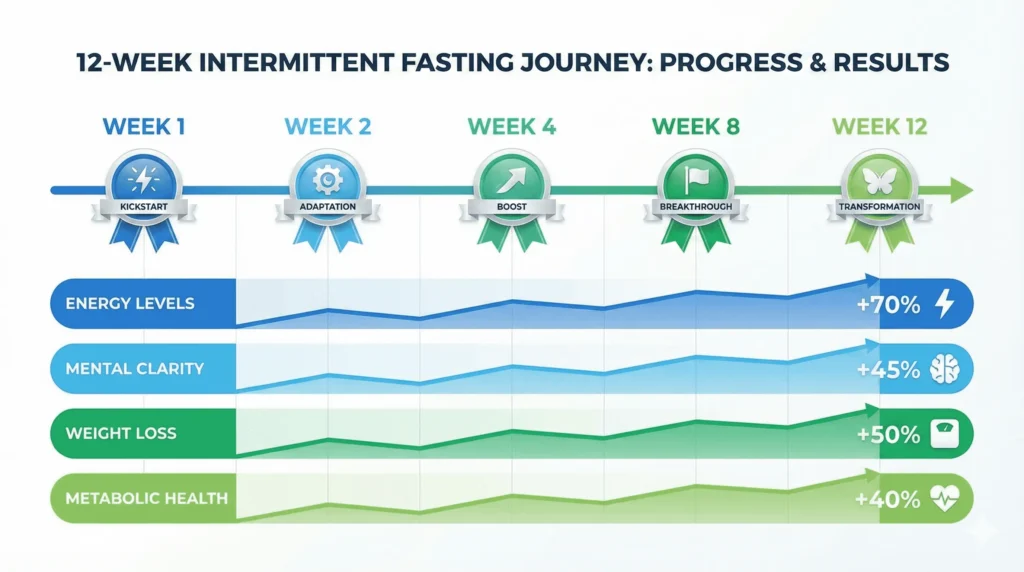
Week 1-2: Adaptation Phase
You’ll feel hungry in the mornings. Might feel tired or irritable. This is your body adjusting.
Weight loss: Maybe 2-3 pounds (mostly water)
Week 3-4: Getting Easier
Hunger decreases. You start feeling more energy in the morning. Mental clarity improves. Your body is getting better at burning fat.
Weight loss: 1-2 pounds per week if you’re losing fat
Week 5-8: Feeling Normal
Fasting feels normal now. Stable energy all day. No more constant hunger. Your metabolism is more flexible. Body composition visibly improving even if the scale isn’t moving much.
Month 3+: Full Adaptation
Fasting is just your eating pattern now—it’s not hard. Sustained fat loss, better energy, improved mental performance. This is when you realize it’s not a “diet,” it’s just how you eat.
Don’t expect instant transformation. This is a 90-day minimum commitment. But unlike crash diets, the benefits compound over time instead of disappearing.
Who Shouldn’t Do Intermittent Fasting
Fasting isn’t for everyone. Here’s who should avoid it or be very careful:
- Pregnant or breastfeeding women. Your body needs consistent nutrients. Don’t fast.
- People with a history of eating disorders. Fasting can trigger restrictive behaviors. If you have any history of anorexia, bulimia, or disordered eating, skip this.
- Type 1 diabetics. Fasting can cause dangerous blood sugar swings. If you’re on insulin, you need medical supervision.
- People on certain medications. Some meds need to be taken with food. Check with your doctor if you’re on any prescriptions.
- Underweight individuals. If you’re already struggling to maintain weight, fasting will make it worse.
- Children and teenagers. Growing bodies need consistent nutrition. Fasting is for adults.
- People with high stress or poor sleep. If you’re chronically stressed or sleeping less than 6 hours, fasting will add more stress to an already overloaded system. Fix your baseline first—check our sleep optimization guide before attempting fasting.
- Anyone with a chronic medical condition. If you have kidney disease, liver problems, or any serious health condition, talk to your doctor first. Fasting changes your metabolism—your doctor needs to know.
This isn’t a joke. If you fall into any of these categories and try to fast anyway, you’re not being “tough”—you’re being reckless. Your body has real limitations. Respect them.
Fasting and Exercise: What Actually Works
Can you work out while fasting? Yes. Should you? Depends on what you’re doing.
✅ Fasted Cardio (Light-Moderate Intensity)
Walking, light jogging, cycling at conversational pace—all work great while fasted. Your body is already in fat-burning mode, so low-intensity cardio taps into that efficiently.
What I do: 30-minute morning walk at 6:30 AM, still fasted. No issue with energy. Actually feels better than walking after eating.
⚠️ Strength Training While Fasted (Not Ideal)
You’ll have less power and strength. Your muscles need glycogen for heavy lifting. If you’re serious about building muscle, train during your eating window or shortly after breaking your fast.
Exception: If you’re already fat-adapted (3+ months of fasting), you might handle fasted strength training fine. But most people perform better fed.
❌ High-Intensity Workouts Fasted (Bad Idea)
HIIT, sprinting, CrossFit-style metcons—these need glycogen. Doing them fasted means you’ll underperform, feel dizzy, and recover slower. Not worth it.
Smart move: Schedule intense workouts 1-2 hours after breaking your fast. Fuel the workout properly.
My Workout Schedule on 16:8
- 6:30 AM: Light cardio (walk, easy bike) — fasted
- 12:00 PM: Break fast with protein + carbs
- 1:00-2:00 PM: Strength training — fueled
- 3:00 PM: Post-workout snack if needed
This way I get fasted cardio benefits without sacrificing workout performance.
Bottom line: Match your workout intensity to your fuel state. Low intensity = fasted is fine. High intensity = eat first.
🔥 The Metabolic Loophole That Keeps Fat Burning During Workouts
Fasted cardio works. But combining it with strategic metabolic activation keeps your body burning fat even after you eat—so you don’t lose momentum when breaking your fast.
→ Amplify Your Fasting Results
Affiliate disclosure: I may earn a commission at no extra cost to you.
Stacking Fasting with Other Metabolic Strategies
Fasting is powerful alone. But when you combine it with complementary strategies, the results accelerate.
Fasting + Real Food (Not Processed Junk)
Fasting doesn’t give you a free pass to eat garbage. During your eating window, what you eat matters more than you think.
- Prioritize: Meat, fish, eggs, vegetables, fruits, nuts, healthy fats
- Minimize: Processed carbs, seed oils, sugar, artificial crap
- Why: Nutrient-dense food supports mitochondrial function. Junk food creates inflammation that cancels out fasting benefits.
Fasting + Quality Sleep (Non-Negotiable)
I’ve said this three times already because it’s that important: Sleep is when autophagy peaks.
If you’re fasting 16 hours but sleeping 5 hours, you’re wasting 70% of the benefit. Your body repairs during deep sleep. No deep sleep = no repair.
Minimum: 7 hours. Optimal: 8-9 hours. Check our sleep optimization guide if you’re struggling.
Fasting + Stress Management (Cortisol Matters)
Chronic stress spikes cortisol. High cortisol tells your body to hold onto fat—especially around your midsection.
Fasting temporarily raises cortisol (it’s a mild stressor). If you’re already chronically stressed, adding fasting can backfire.
Fix stress first: Meditation, walking, breathwork, therapy—whatever works. Then add fasting.
Fasting + Strategic Supplementation
Certain supplements enhance fasting benefits without breaking your fast:
- Electrolytes (sodium, potassium, magnesium): Prevents “keto flu” symptoms during fasting
- Omega-3s: Supports mitochondrial health, reduces inflammation
- CoQ10 / PQQ: Mitochondrial support compounds (see my mitochondria guide)
- L-Carnitine: Helps shuttle fat into mitochondria for burning
These don’t break your fast because they have zero calories. But they amplify the metabolic benefits.
Fasting + Movement (Daily, Not Extreme)
You don’t need to crush yourself in the gym. Just move every day.
- Morning walk: 20-30 minutes, fasted → accelerates fat burning
- Resistance training: 2-3x/week during eating window → preserves muscle
- Daily steps: 8,000-10,000 → keeps metabolism active
Sedentary + fasting = mediocre results. Movement + fasting = compound effect.
The Fasting Stack That Works:
16:8 fasting + whole foods + 8 hours sleep + stress management + daily movement + strategic supplements = metabolic optimization
Here’s the truth: Fasting alone won’t fix a broken lifestyle. But when you stack it with other metabolic strategies, it becomes the catalyst that makes everything else work better.
My Results After One Year of 16:8 (The Real Numbers)
Here’s what actually changed for me. No exaggeration. No Instagram bullshit.
Weight & Body Composition
- Lost 22 pounds over 12 months (not dramatic, but steady)
- Waist circumference: down 3.5 inches
- No rebound weight gain—weight stayed off
- Body composition shifted: less fat, more visible muscle definition
- Key point: Scale weight matters less than how you look and feel
Energy & Mental Clarity
- No more afternoon crashes—energy stable 6 AM to 10 PM
- Morning brain fog: gone
- Focus during fasted hours: sharper than ever
- Caffeine dependency: reduced (used to need 3-4 coffees, now 1-2)
- Biggest surprise: I work better fasted than fed
Hunger & Relationship with Food
- Constant snacking urge: completely gone
- Real hunger vs. boredom eating: now I can tell the difference
- Food tastes better—meals are more satisfying
- No calorie counting, no food guilt, no obsession
- Freedom: I eat when my body needs food, not on a schedule
Blood Markers (Lab Results)
- Fasting glucose: 98 → 87 mg/dL
- Triglycerides: 145 → 92 mg/dL
- HDL (good cholesterol): 45 → 58 mg/dL
- HbA1c: 5.4% → 5.1% (better glucose control)
- Doctor’s comment: “Whatever you’re doing, keep doing it.”
Digestion & Gut Health
- Bloating: significantly reduced
- Digestive discomfort after meals: rare now
- Giving my gut 16 hours to rest = noticeable improvement
- Unexpected benefit: Regular bowel movements (sorry, but it matters)
The Honest Timeline
Months 1-2: Hard. Hungry in mornings. Questioned if it was worth it.
Months 3-4: Clicked. Hunger disappeared. Energy stabilized. Started seeing real changes.
Months 5-12: Autopilot. Fasting is just how I eat now. Results kept compounding.
This wasn’t a quick fix. It took 90-120 days before everything clicked. But now it’s effortless. I don’t think about fasting—I just live.
Frequently Asked Questions (The Real Answers)
Will intermittent fasting slow down my metabolism?
No. Short-term fasting (16-24 hours) does not slow metabolism. In fact, it can slightly increase metabolic rate due to adrenaline and norepinephrine release.
Metabolic slowdown happens with chronic calorie restriction over weeks/months—not from daily 16-hour fasts where you eat adequate calories during your window.
Can I drink coffee with cream during my fast?
Technically, no. A splash of cream has calories and triggers an insulin response—so it breaks your fast.
Realistically? If adding 1 tbsp of cream helps you stick to fasting long-term, the compliance benefit might outweigh the technical break. But for maximum autophagy, stick to black coffee.
Why am I not losing weight with intermittent fasting?
Four most common reasons:
- Eating too much during your window. Fasting isn’t a license to binge. If you eat 3,000 calories in 8 hours, you won’t lose weight.
- Eating processed junk that spikes insulin. Quality matters. Whole foods vs. packaged crap makes a huge difference.
- Hidden calories you’re not tracking. That “handful of nuts” at 3 PM? 300 calories. The olive oil you “drizzled” on your salad? 200 calories. Small bites add up fast. Track honestly for 3 days—you’ll find the problem.
- Not giving it enough time. Weight loss isn’t linear. Give it 8-12 weeks before judging results.
Is intermittent fasting safe for women?
Generally yes, but women’s hormones are more sensitive to fasting than men’s.
Some women do better with:
- Shorter fasts (14 hours instead of 16)
- Taking breaks during luteal phase (second half of menstrual cycle)
- Not fasting every single day
If fasting disrupts your cycle, makes you feel terrible, or kills your energy, shorten your window or take more breaks. Listen to your body.
Can I build muscle while doing intermittent fasting?
Yes. As long as you:
- Eat enough protein (0.8-1g per pound of body weight)
- Consume adequate calories during your eating window
- Train properly (resistance training 2-3x/week)
- Time workouts during your eating window (not fasted)
Many people successfully build muscle on 16:8. The key is eating enough when you do eat.
What if I get really hungry during my fast?
Step 1: Drink water. Most “hunger” is actually thirst. Chug 16 oz and wait 15 minutes.
Step 2: If still hungry, drink black coffee or green tea. Both suppress appetite and enhance autophagy.
Step 3: If genuine, intense hunger persists (not just mild discomfort), eat something. Don’t white-knuckle through extreme hunger—especially when starting out. Build up gradually.
Do I have to fast every single day?
No. I take one day off per week (usually Saturdays). Eat breakfast with my family, enjoy the morning without fasting.
Consistency matters more than perfection. If you fast 6 days a week, you’ll still get 85% of the benefits. Life happens—don’t stress about occasional breaks.
Can I take supplements during my fast?
Zero-calorie supplements: Yes. Electrolytes, magnesium, fish oil, CoQ10—these don’t break your fast.
Protein powder, BCAAs, fat-based supplements: No. These have calories and break your fast.
If a supplement needs to be taken with food (check the label), take it during your eating window.
Final Thoughts: Fasting Is Maintenance, Not Punishment
Intermittent fasting isn’t magic. It’s not a hack. It’s not a shortcut.
It’s a tool that lets your body do what it’s already designed to do: clean house, repair damage, optimize energy production.
The first time I tried fasting, I treated it like a diet—something to endure until I hit my goal weight. I focused on restriction. I white-knuckled through hunger. I quit after a month.
The second time, I treated it like cellular maintenance. I focused on what my body was doing during those fasted hours: autophagy activating, mitochondria regenerating, inflammation decreasing.
That mindset shift changed everything.
If You Do Nothing Else, Do This:
- Start with 14:10 for two weeks. Get used to the rhythm. Then move to 16:8.
- Drink water constantly. Add a pinch of salt. Most “hunger” is thirst.
- Break your fast with real food. Protein + healthy fat + vegetables. Not donuts.
- Sleep 7-8 hours minimum. Fasting without sleep = wasted effort.
- Give it 90 days. Don’t judge results after 2 weeks. Your body needs time to adapt.
Fasting won’t fix a broken lifestyle. But if you’re already eating reasonably well, moving daily, and managing stress—fasting becomes the catalyst that amplifies everything else.
Your body already knows how to fast. You did it every night as a kid. You’re just extending that natural overnight fast a few more hours.
Here’s what nobody tells you: The first two weeks suck. Week three is tolerable. Week four, you forget you’re even fasting. Month three, you realize this isn’t a diet—it’s just how you eat now. Month six, you can’t imagine going back.
That’s when fasting stops being something you do and becomes who you are metabolically.
Give it 90 days. Your cells will thank you.
🔓 The Metabolic Loophole That Turns 90-Day Fasting Results Into 45-Day Reality
Fasting works. But it works twice as fast when you activate the metabolic pathways most people ignore. This is the exact protocol I used to break through my 8-week plateau—when fasting alone stopped working. Fat loss resumed. Energy doubled. Results accelerated.
→ Discover the Lean Loophole Now
Affiliate disclosure: I may earn a commission at no extra cost to you.

Elena Hartwell is a wellness educator specializing in sleep optimization, metabolic health, and natural weight management. After years of struggling with exhaustion and unexplained weight gain despite “doing everything right,” Elena discovered the powerful connection between sleep quality, gut health, and metabolism—a breakthrough that transformed her life and inspired her mission. Today, she translates cutting-edge research into simple, actionable strategies that help readers sleep better, lose stubborn weight naturally, and reclaim their energy. Elena’s evidence-based approach has helped thousands break free from the diet-exercise cycle by addressing the root cause: disrupted sleep and metabolic dysfunction.