Why You’re Tired Despite “Enough” Sleep
Sleeping 8 hours doesn’t guarantee restorative sleep. Here’s what breaks sleep quality even when you’re in bed long enough:
1. You’re Not Getting Enough Deep Sleep
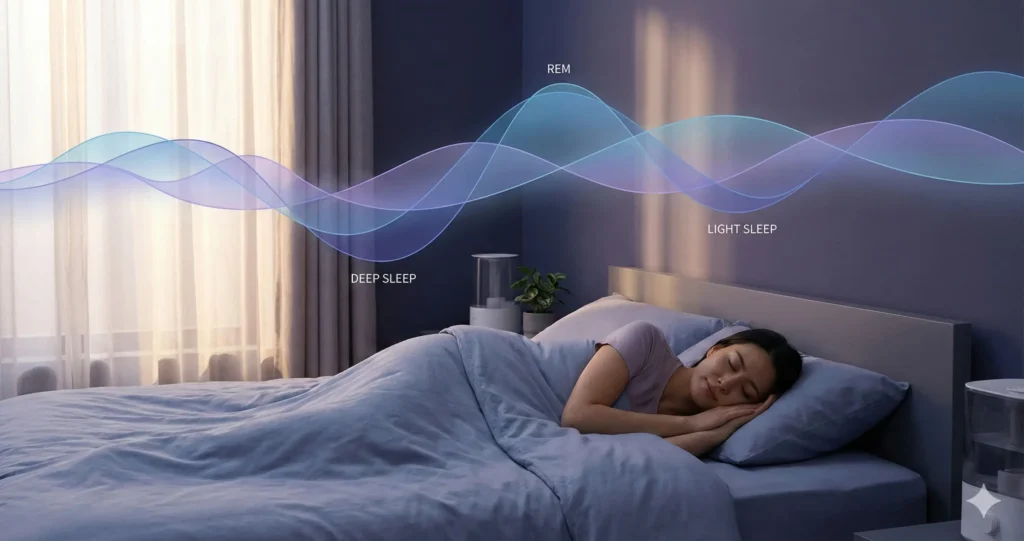
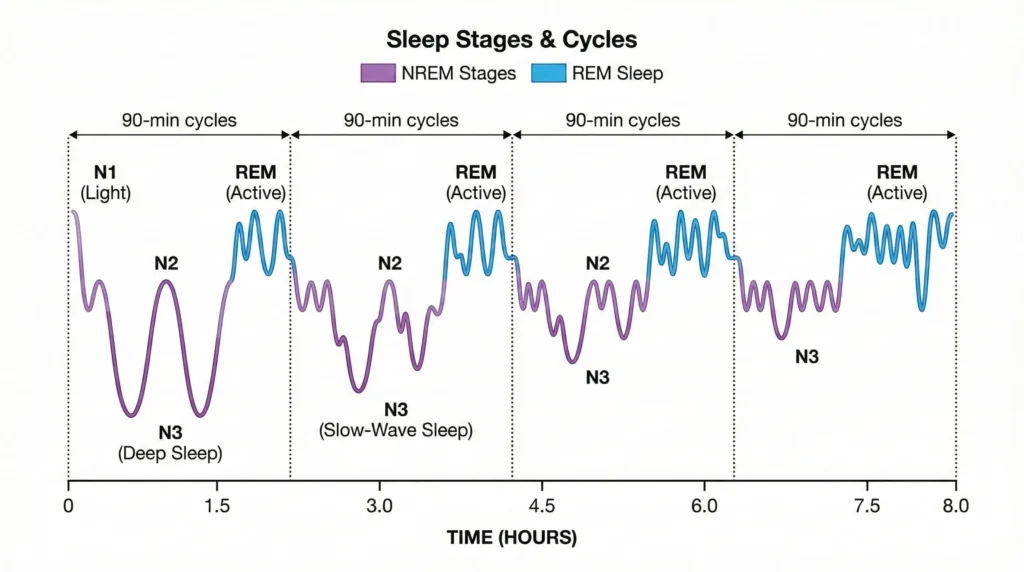
Deep sleep (Stage 3) is when your body physically restores itself. Tissue repair, muscle growth, immune function, hormone regulation—it all happens here.
You need 15-25% of your total sleep time in deep sleep. For an 8-hour night, that’s about 75-120 minutes total.
If you’re only getting 30-40 minutes of deep sleep, you’ll wake up tired no matter how long you slept.
What blocks deep sleep:
– Alcohol (you fall asleep faster but never reach deep stages)
– Stimulants too close to bedtime (caffeine after 2 PM)
– High stress (cortisol stays elevated, prevents deep sleep)
– Poor sleep environment (too hot, too noisy, too bright)
– Sleep apnea (breathing stops repeatedly, pulling you out of deep sleep)
2. Your REM Sleep Is Fragmented
REM sleep is when your brain consolidates memories, processes emotions, and clears out metabolic waste. Without enough REM, you wake up mentally foggy, emotionally unstable, and unable to focus.
You need 20-25% of your sleep in REM. That’s about 90-120 minutes per night.
REM cycles get longer as the night progresses. Your first REM period might be 10 minutes. By your last cycle, you’re spending 30-60 minutes in REM.
If you cut your sleep short—even by 30-60 minutes—you’re mostly losing REM sleep. This is why “just six hours” feels so much worse than eight. You’re cutting off the most mentally restorative part of the night.
What disrupts REM sleep:
– Alcohol (suppresses REM entirely)
– Antidepressants and some medications
– Sleep disorders (apnea, restless leg syndrome)
– Waking up too early (before completing final REM cycles)
– High bedroom temperature (REM is temperature-sensitive)
3. You’re Waking Up Multiple Times (Even If You Don’t Remember)
Sleep continuity matters as much as sleep duration.
Microarousals—brief awakenings lasting just seconds—pull you out of deep or REM sleep and restart the cycle. You might not consciously remember these awakenings, but your sleep tracker or a sleep study would show them.
Even 5-10 microarousals per hour can completely destroy sleep quality. You spend the entire night stuck in light sleep (Stage 1 and 2), never reaching the restorative stages.
Common causes of fragmented sleep:
– Sleep apnea (breathing stops, you wake briefly to restart breathing)
– Restless leg syndrome
– Chronic pain
– Overactive bladder (waking to pee multiple times)
– Anxiety (hyperarousal keeps brain too active)
– Partner movement or snoring
– Pets in bed
– Temperature fluctuations (too hot or cold)
4. Your Circadian Rhythm Is Misaligned
Your body has an internal clock that regulates when you should sleep and wake. When this clock is out of sync with your actual sleep schedule, the quality of your sleep suffers—even if you get enough hours.
This is why shift workers sleep poorly even when they sleep 8+ hours during the day. Their circadian rhythm is screaming “it’s daytime, you should be awake!” while they’re trying to sleep.
What throws off your circadian rhythm:
– Inconsistent sleep schedule (bedtime varies by 2+ hours)
– Late-night blue light exposure (screens before bed)
– No morning sunlight exposure
– Eating late at night (food is a circadian signal)
– High stress (cortisol disrupts the natural rhythm)
Your morning energy actually starts the night before. Check out our evening habits guide to learn how to optimize your circadian rhythm.
5. Sleep Inertia Is Worse for You
Ever wake up feeling like you’re moving through mud? That’s sleep inertia—the grogginess that lasts 15-30 minutes after waking.
Everyone experiences some sleep inertia, but for some people it’s debilitating and lasts hours.
Why sleep inertia is worse for some:
– Waking during deep sleep (worst time to wake up)
– Sleep deprivation (builds up over days/weeks)
– Poor circadian alignment (waking when body wants to sleep)
– Low sleep quality (fragmented sleep makes inertia worse)
If you’re waking up mid-deep-sleep cycle, you’ll feel destroyed. This is why waking naturally feels better than an alarm. Your body wakes between cycles when you’re in light sleep, not during deep or REM.
Sleep Trackers: Do They Actually Help?
I used sleep trackers (Oura Ring, Whoop, Apple Watch) for two years. Here’s what I learned:
What they’re good at:
– Tracking total sleep time
– Detecting patterns (bedtime consistency, wake-ups)
– Showing when you went to bed and woke up
– Heart rate and heart rate variability trends
What they’re terrible at:
– Accurately measuring sleep stages (they guess based on movement and heart rate)
– Diagnosing sleep disorders (you need a real sleep study for that)
– Telling you WHY your sleep is poor
Sleep trackers made me obsess over numbers that weren’t even accurate. I’d wake up, check my “sleep score,” and immediately feel anxious if it was low.
Here’s a better approach: Track how you feel when you wake up. Rate your energy 1-10. Do this for 30 days. You’ll notice patterns—certain behaviors (alcohol, late meals, screen time) consistently correlate with feeling worse.
You don’t need a $300 ring to tell you that drinking wine before bed makes you sleep poorly. You already know.
If you suspect a real sleep disorder (apnea, narcolepsy, severe insomnia), get a proper sleep study. Don’t rely on consumer trackers.
What Actually Improves Sleep Quality
Forget the complicated sleep optimization protocols. Here’s what actually works:
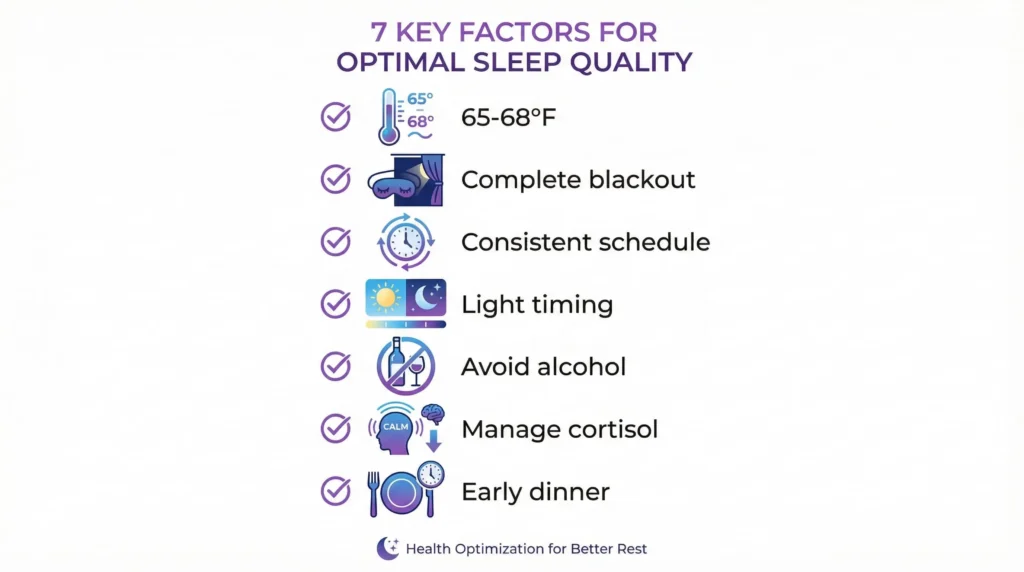
Fix Your Sleep Environment
Your bedroom should be optimized for sleep, not for scrolling Instagram.
Temperature: 65-68°F (18-20°C) is ideal. Your body needs to cool down to sleep deeply. If your room is too warm, you’ll spend more time in light sleep and wake up frequently. I use a fan year-round.
Darkness: Complete darkness. Even small amounts of light suppress melatonin and disrupt sleep. Blackout curtains. Cover LED lights. No nightlights. If you wake up to pee, use dim red lights—red wavelengths don’t suppress melatonin like blue/white light does.
Sound: Quiet or consistent white noise. If you live somewhere noisy, use a white noise machine or fan. Inconsistent sounds (traffic, neighbors, dogs) cause microarousals that fragment sleep.
Mattress and pillows: If you’re waking up with back pain or neck pain, your bed is the problem. You spend a third of your life in bed—invest in quality.
Consistent Sleep Schedule
This is the single most important factor for sleep quality.
Go to bed and wake up at the same time every day. Yes, including weekends.
Varying your sleep schedule by even 2 hours confuses your circadian rhythm. Your body doesn’t know when to produce melatonin or cortisol. Sleep quality suffers.
I go to bed at 10 PM and wake at 6 AM. Every day. No exceptions. After two weeks of this, I started waking up naturally before my alarm. My body adapted.
If you’re currently all over the map with sleep timing, pick a target schedule and stick with it for 30 days. Your sleep quality will improve dramatically.
Light Exposure Timing
Light is the most powerful signal for your circadian rhythm.
Morning: Get outside within 30-60 minutes of waking. Even 60-90 seconds of sunlight exposure tells your brain “it’s daytime, time to be alert.” This sets your circadian clock and improves sleep quality that night. Our morning routine guide covers this in detail.
Evening: Dim lights after sunset. Avoid bright overhead lights. Use lamps, candles, or warm-toned bulbs. If you must use screens, enable night mode or wear blue-blocking glasses.
Night: No screens 1 hour before bed. I know this is hard. But blue light from phones, tablets, and computers suppresses melatonin for 2-3 hours. You’re sabotaging your own sleep.
Read a book. Talk to your partner. Stretch. Meditate. Just don’t scroll.
Stop Drinking Alcohol
I hate this one too, but it’s true.
Alcohol ruins sleep quality. Yes, it makes you fall asleep faster. But it blocks REM sleep and causes fragmented sleep in the second half of the night.
You might sleep 8 hours after drinking, but you’re getting maybe 4 hours of actual restorative sleep. That’s why you wake up feeling terrible even after “enough” sleep.
If you drink, stop at least 3-4 hours before bed. Better yet, don’t drink at all on weeknights.
Manage Stress and Cortisol
High cortisol prevents deep sleep. If you’re stressed, anxious, or mentally wired at night, your body stays in “fight or flight” mode. Deep sleep requires a relaxed nervous system.
What helps:
– Evening wind-down routine (30-60 minutes before bed)
– Breathwork or meditation (even 5 minutes)
– Journaling (dump your thoughts on paper)
– Magnesium supplement (400mg before bed—helps with relaxation)
– No work, email, or stressful content after 8 PM
I take magnesium glycinate every night. It’s one of the few supplements that noticeably improves my sleep depth. More on supporting cellular energy and sleep in our mitochondrial health guide.
Time Your Meals and Caffeine Correctly
Caffeine: Stop by 2 PM. Caffeine has a half-life of 5-6 hours. If you drink coffee at 4 PM, half of it is still in your system at 10 PM. You might fall asleep, but your sleep will be lighter and more fragmented.
Food: Finish eating at least 2-3 hours before bed. Late meals spike blood sugar and insulin, which interfere with sleep quality. Your body should be fasting and repairing during sleep, not digesting food.
Exception: A small protein-rich snack 1-2 hours before bed can help if you’re genuinely hungry. A handful of nuts, Greek yogurt, or a boiled egg. Not a full meal.
If you’re practicing intermittent fasting, make sure your eating window doesn’t extend too late. Learn more about fasting and sleep quality.
When to Suspect a Sleep Disorder
Sometimes poor sleep isn’t just bad habits. It’s a medical issue.
Sleep Apnea
This is the most common and dangerous sleep disorder. Your breathing stops repeatedly during the night—sometimes hundreds of times. Each time it stops, your brain wakes you briefly to restart breathing.
You never reach deep or REM sleep. You wake up exhausted despite sleeping 8+ hours.
Signs of sleep apnea:
– Loud snoring
– Waking up gasping or choking
– Morning headaches
– Excessive daytime sleepiness
– High blood pressure
– Weight around the neck/chest
– Partner says you stop breathing during sleep
If you suspect sleep apnea, get a sleep study. It’s treatable with CPAP machines, oral appliances, or in some cases, surgery. Untreated sleep apnea is linked to heart disease, diabetes, and early death.
Restless Leg Syndrome (RLS)
Uncontrollable urge to move your legs, especially at night. Makes it hard to fall asleep and causes frequent awakenings.
Often linked to iron deficiency, magnesium deficiency, or nerve issues. Treatable with supplements or medication.
Chronic Insomnia
Difficulty falling asleep or staying asleep at least 3 nights per week for 3+ months, despite having adequate opportunity to sleep.
This isn’t just “I can’t sleep tonight.” It’s a persistent pattern. Often related to anxiety, depression, chronic pain, or poor sleep conditioning (your brain associates bed with wakefulness instead of sleep).
Cognitive behavioral therapy for insomnia (CBT-I) is the gold standard treatment. More effective than sleeping pills and no side effects.
Circadian Rhythm Disorders
Your internal clock is permanently misaligned with the 24-hour day. You might be a natural “night owl” whose circadian rhythm runs 2-3 hours later than normal. Or you have delayed sleep phase syndrome, where you can’t fall asleep until 2-3 AM no matter what you do.
These are real medical conditions, not just “bad habits.” Light therapy, melatonin timing, and sometimes chronotherapy (gradually shifting sleep time) can help.
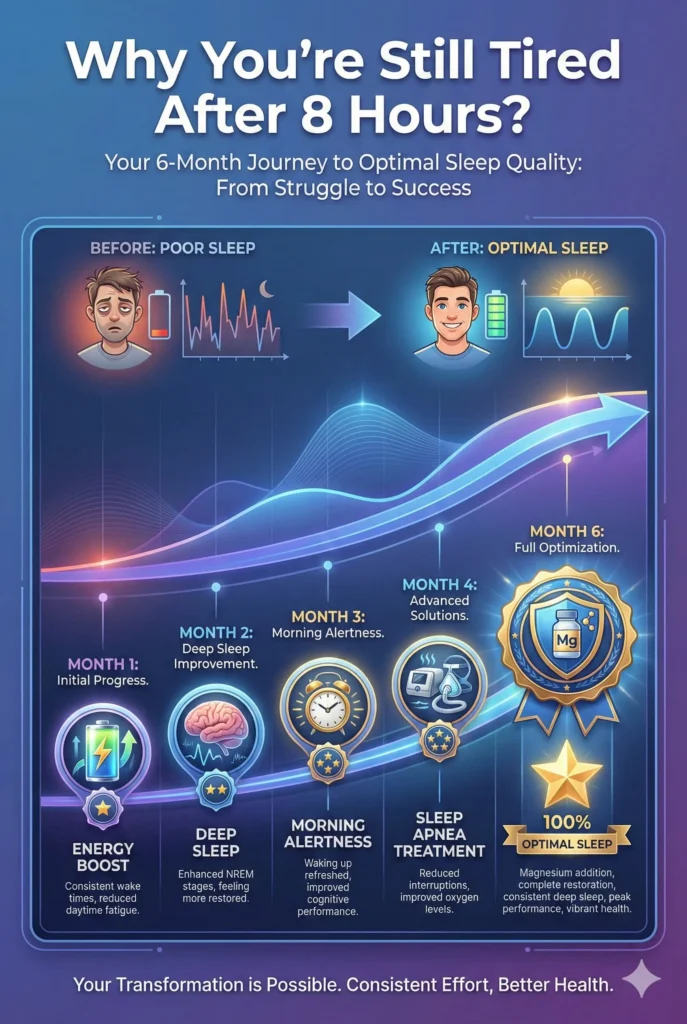
My Sleep Transformation: What Actually Worked
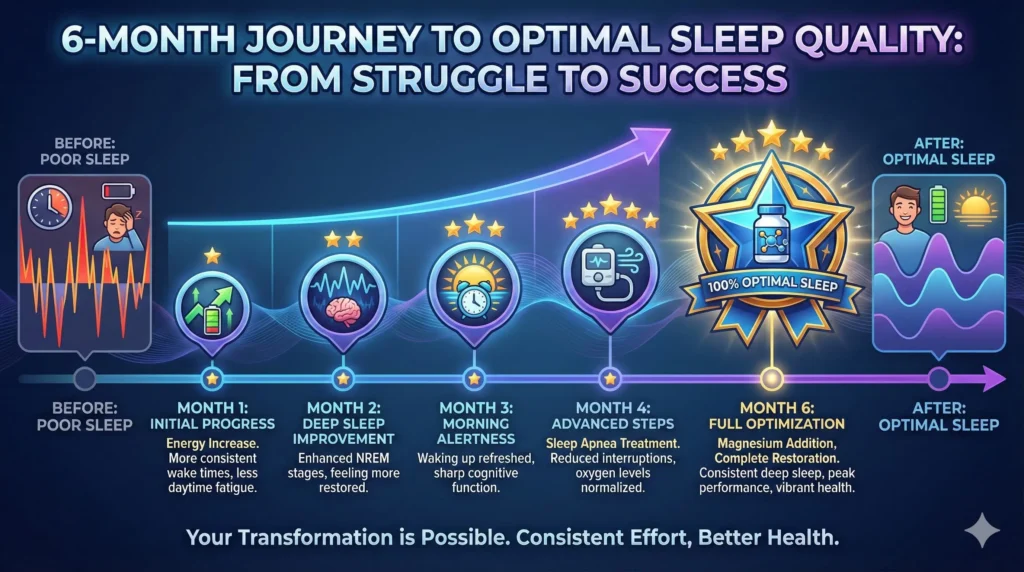
For three years, I slept 8 hours and woke up exhausted. Here’s what changed:
Sleep study revealed mild sleep apnea. I wasn’t a classic candidate—not overweight, no loud snoring. But I was having 8-10 breathing disruptions per hour. Enough to fragment my sleep and prevent deep sleep.
I started using a CPAP machine. It sucked at first. Uncomfortable, annoying, felt like I couldn’t breathe. But after two weeks of adjustment, my sleep quality transformed overnight.
Consistent sleep schedule. 10 PM to 6 AM. Every night. Even weekends. Even vacations. This alone improved my sleep more than any supplement or hack.
Morning sunlight exposure. I step outside for 60-90 seconds every morning within 30 minutes of waking. This locked in my circadian rhythm. Now I wake up before my alarm most days.
No alcohol on weeknights. I drink on weekends occasionally, but not before midnight on any night I need to function the next day.
Magnesium glycinate before bed. 400mg. Helps me relax and increases deep sleep. I notice a difference on nights I forget to take it.
Cool bedroom. 67°F with a fan. Complete darkness with blackout curtains.
Results after 6 months: I wake up feeling refreshed 5-6 days per week. Energy is stable all day. No afternoon crashes. Mental clarity is sharp. I don’t need coffee to function anymore (though I still drink it).
The key wasn’t sleeping more hours. It was improving the quality of those hours.
Frequently Asked Questions
How do I know if my sleep quality is poor?
Simple test: How do you feel when you wake up? If you’re consistently tired, groggy, unmotivated, or need 30+ minutes to feel functional, your sleep quality is poor. Other signs include needing multiple alarms, falling back asleep immediately after waking, frequent yawning throughout the day, and difficulty concentrating.
Can I “catch up” on sleep on weekends?
Not really. While extra sleep on weekends helps reduce sleep debt, it doesn’t fully restore cognitive function or repair the damage from chronic sleep deprivation. More importantly, sleeping in on weekends disrupts your circadian rhythm, making it harder to sleep well during the week. Better to maintain a consistent schedule.
Is 6 hours of high-quality sleep better than 8 hours of poor sleep?
It’s complicated. Six hours of uninterrupted, deep, restorative sleep is better than eight hours of fragmented, shallow sleep. But most people need 7-9 hours of good sleep for optimal health. Six hours, even if high quality, still creates cumulative sleep debt over time.
Do sleep supplements work?
Some do. Magnesium glycinate (400mg) improves sleep depth for many people. Melatonin (0.5-3mg) can help with circadian timing but doesn’t necessarily improve sleep quality. Most other supplements (valerian, chamomile, CBD) have weak or inconsistent evidence. Fix your sleep environment and habits first before adding supplements.
Why do I wake up at 3 AM every night?
This is often related to blood sugar crashes, stress/anxiety, or natural sleep cycle transitions. If you eat dinner early or don’t eat enough, blood sugar can drop around 3-4 AM, waking you up. High cortisol from stress can also cause early-morning waking. Try a small protein snack before bed and work on stress management.
Should I nap during the day if I’m tired?
Short naps (20-30 minutes) before 3 PM can help with alertness without affecting nighttime sleep. Longer naps or naps after 3 PM can make it harder to fall asleep at night. If you need to nap every day, your nighttime sleep quality is probably poor and needs to be addressed.
Does exercise improve sleep quality?
Yes, but timing matters. Regular exercise improves deep sleep and sleep continuity. But intense exercise within 2-3 hours of bedtime can be stimulating and delay sleep onset. Morning or afternoon exercise is ideal. Even light activity like walking helps.
Final Thoughts
You’re not broken. Your sleep is.
Most people focus on sleep quantity—”I need 8 hours”—and ignore sleep quality. But 8 hours of fragmented, shallow sleep leaves you just as exhausted as 5 hours of deep, restorative sleep would leave you refreshed.
The solution isn’t sleeping more. It’s sleeping better.
Fix your sleep environment. Maintain a consistent schedule. Get morning sunlight. Cut out alcohol and late caffeine. Manage stress. If you’ve done all this and still feel terrible, get a sleep study.
Sleep is the foundation of everything. Energy, mood, focus, metabolism, immune function—it all starts with quality sleep.
Once I fixed my sleep quality, everything else improved. My energy stabilized. I stopped needing coffee to function. My workouts improved. My mood leveled out. Brain fog disappeared.
All because I finally understood that sleep isn’t just about hours in bed. It’s about what happens during those hours.
For more on optimizing your energy throughout the day, check out our guides on morning routines, cellular energy, and diet and metabolism.
Your best sleep is ahead of you.

Elena Hartwell is a wellness educator specializing in sleep optimization, metabolic health, and natural weight management. After years of struggling with exhaustion and unexplained weight gain despite “doing everything right,” Elena discovered the powerful connection between sleep quality, gut health, and metabolism—a breakthrough that transformed her life and inspired her mission. Today, she translates cutting-edge research into simple, actionable strategies that help readers sleep better, lose stubborn weight naturally, and reclaim their energy. Elena’s evidence-based approach has helped thousands break free from the diet-exercise cycle by addressing the root cause: disrupted sleep and metabolic dysfunction.